Finding an apartment in Geneva in 2026: a realistic guide

The short answer
To find an apartment in Geneva, get your application ready before the first viewing, reply fast and knock on several doors at once: letting agencies, tenants leaving before their lease ends and, if you qualify, subsidised housing from the canton or the City. And allow time: on 1 June 2026, the whole canton had 574 apartments standing empty and for rent.
You sometimes read online that the vacancy rate is "0.5 to 0.7%", with no source or date. Instead, we rely on the figures of the Cantonal Statistics Office (OCSTAT), the conditions published by the canton and the City of Geneva, and what the law actually allows a letting agency to ask you.
Why it is so hard: 0.31% of homes are vacant
On 1 June 2026, 0.31% of homes in the canton were vacant, down from 0.34% a year earlier, according to OCSTAT's August 2026 statistical bulletin (in French). You have to go back to 2011 to find a lower rate. Behind that percentage there are very few homes: 793 empty and on the market, of which 682 were apartments. Of those apartments, 574 were for rent and the rest for sale. For scale, the canton had 252,906 apartments a year earlier, according to the Council of State order we come back to below.
A home only counts if it is empty, fit to live in and on offer on the day of the count: an apartment re-let within two days never shows up. Still, the figure tells you what matters: on the day you start looking, almost nothing is free right away.
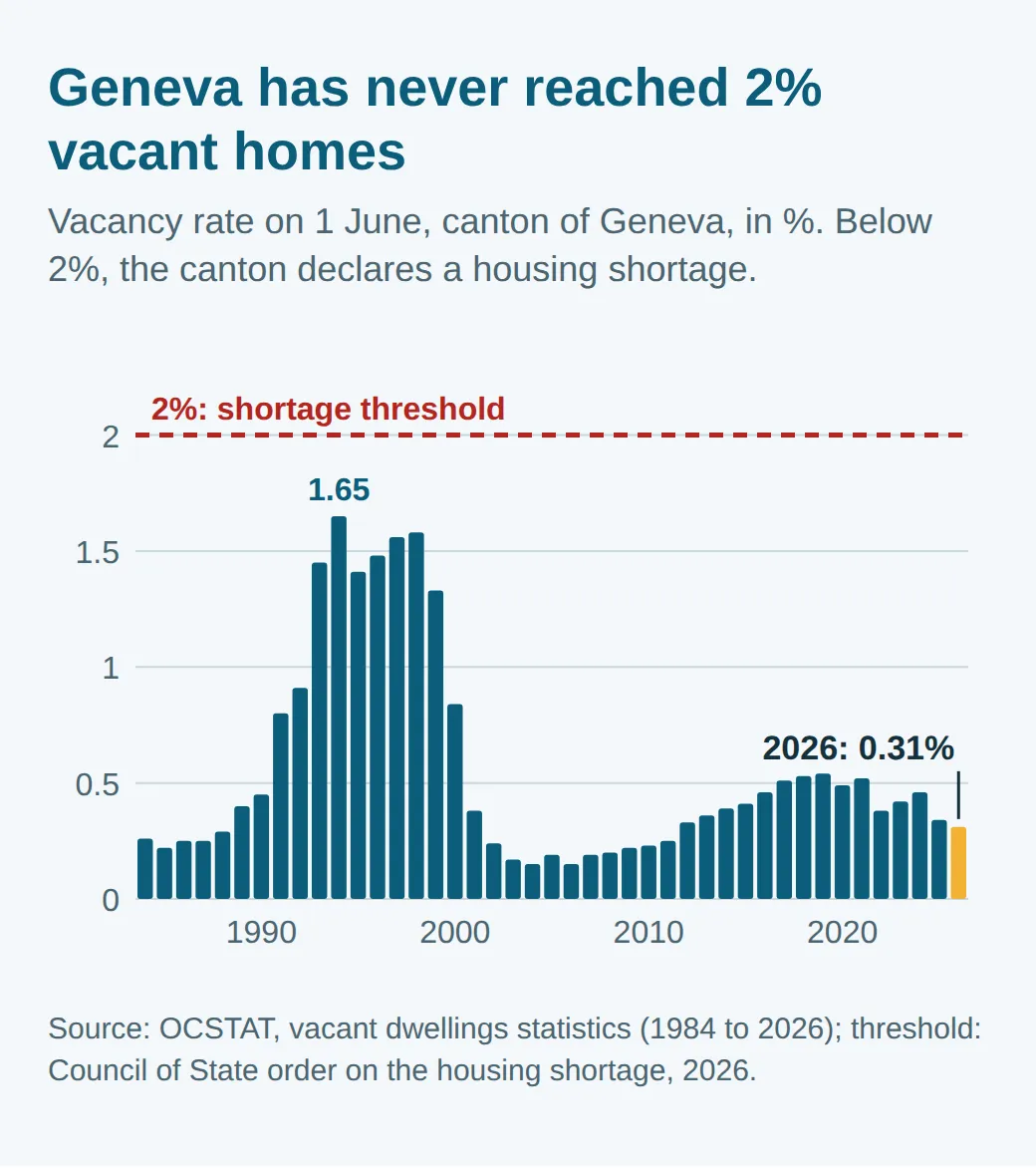
The Council of State, Geneva's government, draws a legal consequence from this every year. Its order for 2026 (in French) declares a shortage in every category of apartment, from 1 room to 7 rooms and more, because the vacancy rate of each is below 2%. In OCSTAT's series, which goes back to 1975, the canton has never reached that threshold: its peak dates from 1994, at 1.65%.
The pressure is not the same everywhere. Apartments with 4 and 5 rooms are the scarcest (0.24% and 0.23% vacant), those with 7 rooms or more the least scarce (0.80%). The city of Geneva, with 427 vacant homes, more than half the total, and a rate of 0.37%, is slightly less tight than the cantonal average. Vernier (0.29%) and Carouge (0.25%) are already below that average, and the other large municipalities even more so: 0.12% in Lancy, 0.14% in Onex, 0.18% in Thônex and 0.20% in Meyrin. Searching only in the suburbs "to improve your chances" doesn't hold up: widen your criteria on size and neighbourhood instead.
Before you start, it's worth knowing what you will pay, and what the word "room" means here.
What rent to expect on a new lease
An apartment that is re-let costs a good deal more than the average rent on existing leases. In May 2025, according to OCSTAT's rent tables (in French), a 4-room apartment at free-market rent cost CHF 1,639 a month on average, excluding charges, but CHF 2,006 when it had been let to a new tenant within the previous twelve months. That second figure is the one that applies to you.
| Size (kitchen included) | All free-market leases | New tenants | HBM |
|---|---|---|---|
| 2 rooms | 1,061 | 1,258 | 547 |
| 3 rooms | 1,365 | 1,626 | 752 |
| 4 rooms | 1,639 | 2,006 | 980 |
| 5 rooms | 1,959 | 2,496 | 1,270 |
Average monthly rents in francs, excluding charges, in May 2025. The HBM column, for subsidised housing, includes no surcharge or allowance.
Note the heading of the first column. Geneva's statistics count the kitchen as a room: a Geneva 4-room apartment may have just a living room and two bedrooms. So compare floor areas in square metres and look at the floor plan, especially if you come from a region or a country that counts rooms differently.
The gap keeps widening. Between May 2025 and May 2026, OCSTAT measured a 7.9% rise in rents on free-market homes that changed tenants, compared with 0.7% for those where the tenant stayed. Small homes turn over more often: more than 11% of 1- and 2-room apartments and more than 8% of 3-room ones changed tenants in a year, compared with under 7% of those with 5 rooms or more. If you can live in a smaller place, you will see more offers.
Geneva has its own safeguard against these increases. As long as the shortage lasts, the landlord must use an official form (in French) for every new lease. It shows the previous tenant's rent, the new rent and the reason for any increase, and you must receive it no later than the day you get the keys. Keep it: it is the basis if you want to challenge the initial rent, which you can do within 30 days of getting the keys.
That leaves the question of where to knock.
Four doors to knock on at once
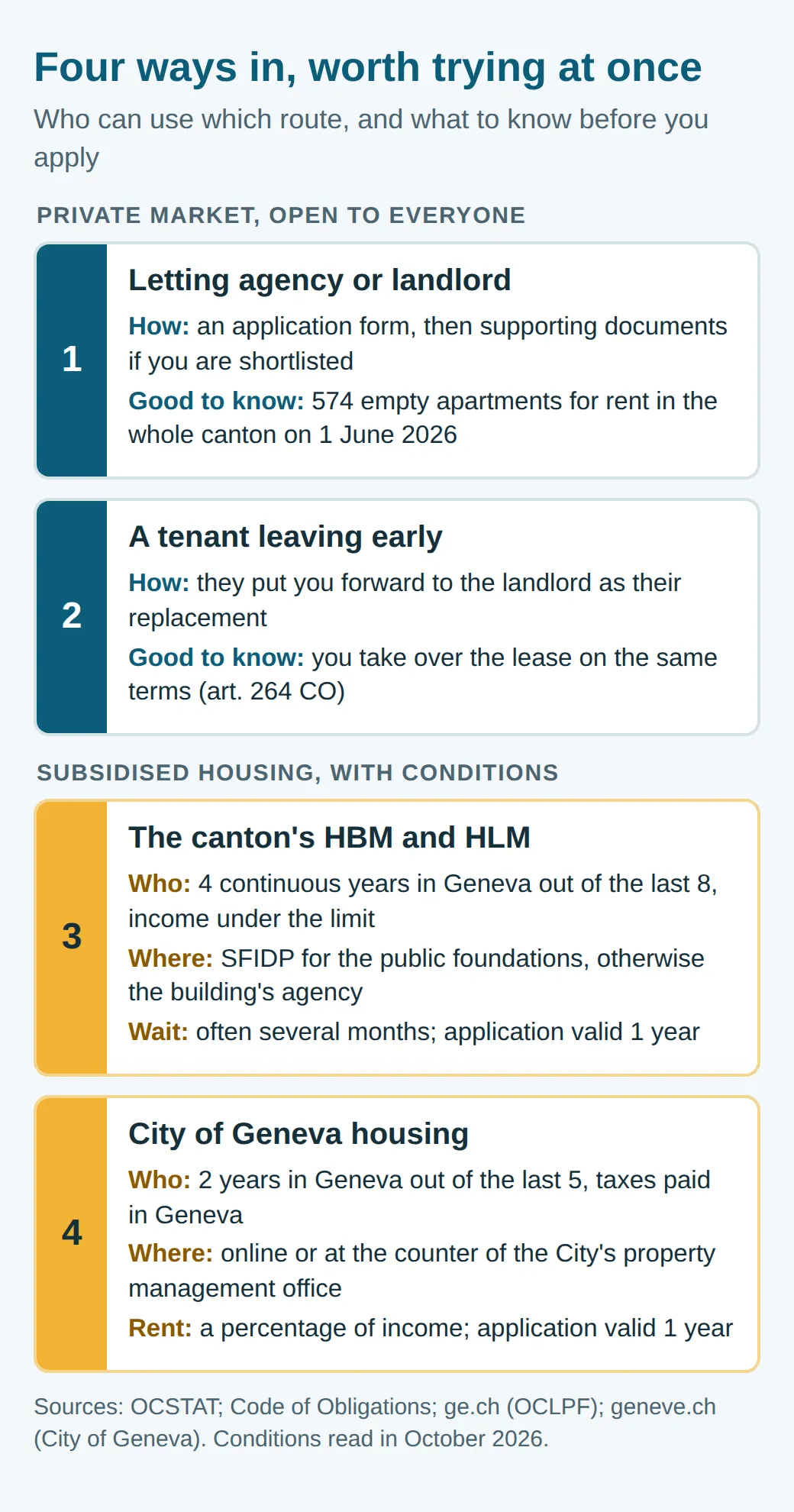
There are four ways to get a home in Geneva, and you can use several of them in parallel. The first two are open to everyone; the other two require a few years of residence in Geneva, and the canton also sets an income ceiling.
Letting agencies and landlords
On the private market, you usually deal with a letting agency, a régie in Geneva, which lets the apartment on the owner's behalf. It organises the viewings and receives the applications. Send a complete form on the day of the viewing.
The Federal Data Protection and Information Commissioner (FDPIC) describes a two-step process. First, everyone interested fills in a standard form. Only then does the agency ask the applicants it has shortlisted for supporting documents: a copy of your ID, proof of income, references. Asking everyone for everything from the outset is considered disproportionate. We come back to this below, with a list of what you can be asked for.
A tenant leaving early
A tenant who wants to leave without waiting for the end of the notice period is only released if they put forward a new tenant who is solvent, whom the landlord cannot reasonably refuse, and who takes over the lease on the same terms. That is the rule in Article 264 of the Code of Obligations. Without a replacement, they pay the rent until the next date on which the lease can end.
So that tenant has every reason to find you, and fast. Watch for listings from people looking for someone to take over their lease, and spread the word at work and among friends. The landlord still has a say on whether you can pay, and you take over the existing rent. One word of caution: if you are told to buy furniture or make some other payment as a condition of getting the lease, such a tie-in transaction is void when it has no direct link with the use of the home.
HBM, HLM and HM: the canton's subsidised housing
The canton supports three categories of housing, described on its page on subsidised housing (in French). HBM (habitations bon marché, low-cost housing) are for people on very low incomes and mostly belong to public-law property foundations. HLM (habitations à loyer modéré, moderate-rent housing) are for people on low incomes. HM (habitations mixtes, mixed housing) combine homes with and without personal rent support in the same building. The state controls the rents, and the table above shows the gap: CHF 980 on average for a 4-room HBM apartment.
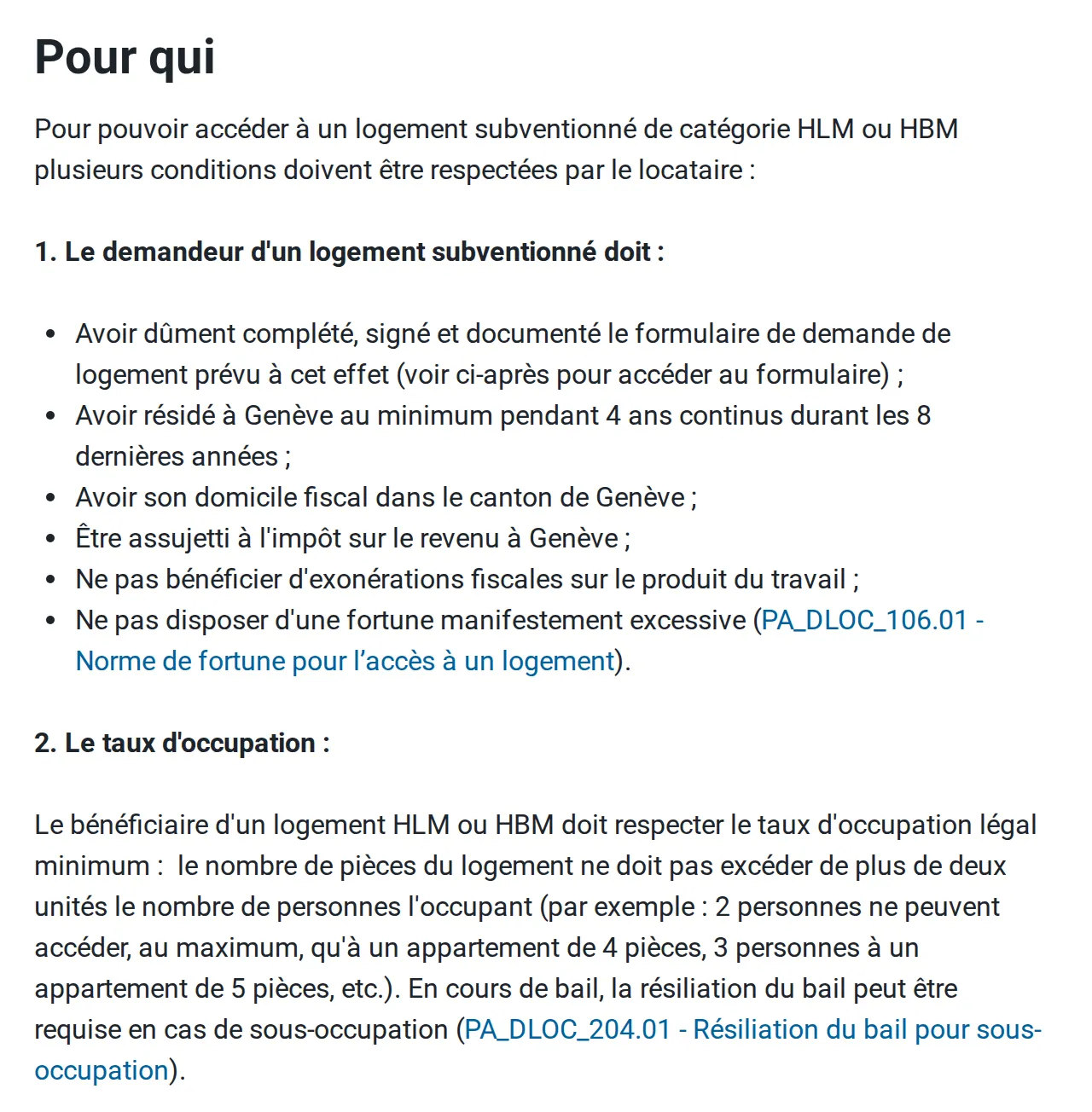
The condition that rules out the most newcomers is the first: having lived in Geneva for at least 4 continuous years out of the last 8 (in French). Next comes income. The canton adds up the income of everyone who will live in the home, social benefits included, plus one fifteenth of net wealth, then deducts CHF 10,000 for the first person, CHF 7,500 for the second and CHF 5,000 for each one after that. It compares this amount with the rent using a rent-to-income ratio (the taux d'effort) of 19% to 29%, depending on the number of rooms per person. The page's own example: a household of 3 aiming for a 4-room HLM or HBM apartment at CHF 15,400 a year must have an income below CHF 88,500 before the per-person deductions, or CHF 66,000 once they are taken off.
Where you apply depends on who owns the building. For buildings owned by the public foundations, and for the 20% of homes elsewhere that the state allocates itself, the form goes to the foundations' secretariat (SFIDP) at avenue Sainte-Clotilde 11. In buildings owned by other landlords, where the letting agency chooses 80% of tenants on the owner's behalf, you apply directly to the agency, on its own form. Applying is free. An application is valid for one year: it closes by itself the day after it expires unless you renew it, on the form provided, one month beforehand. The canton is frank about the wait: demand outstrips supply, and waits "often exceed several months".
City of Geneva housing
The City of Geneva and its foundation for social housing together manage more than 6,000 social housing units, and have handled applications jointly since April 2026. The residence condition is shorter than the canton's: you must have lived in Geneva for at least 2 years out of the last 5 (in French), pay your taxes in Geneva and own no home in the canton or the surrounding region. Priority goes in particular to people without a home, people who have to be rehoused, and people living in an unsuitable or unhealthy apartment.
You can apply online, with a Geneva State e-démarches account or a SwissID account, or on paper at the counter of the City's property management office, the Gérance immobilière municipale, at rue de l'Hôtel-de-Ville 5. The form is the same as the SFIDP's, and the City asks you to submit it to both. The rent is generally set as a percentage of household income. As with the canton, an application is valid for one year; you can renew it from one month before it expires.
Whichever door you choose, it all comes down to your application in the end.
Your application: what a letting agency can ask for
A letting agency can check that you can pay the rent, not pry into your private life. The FDPIC's guidelines (in French; also in German and Italian), updated in July 2025, draw the line. On the form, the agency may ask for your identity and contact details, your occupation and employer, your approximate annual income, any debt enforcement proceedings under way and loss certificates (unpaid debts) from the last five years, the number of occupants, and whether your previous lease was ended by the landlord and why. A copy of your extract from the debt collection register can be requested from every applicant.
Other questions are not allowed, in principle: your marital status, your religion, your nationality (only "Swiss or foreign" and the type of permit with its expiry date are allowed), how long you have been in your current lease and how much rent you pay now. One-off questions about a leasing contract, a small loan or an assignment of wages are not allowed either. References from your employer or previous landlord may only be taken with your consent, and only if you are seriously in the running. Nor can the agency ask whether you would be willing to take out insurance with it.
What is worth having ready before the first viewing:
- a recent extract from the debt collection register: in Geneva, it costs CHF 17 online (in French) with an e-démarches account, and the email that lets you download it arrives the same day or the next working day;
- your residence permit and, if you are changing jobs, your contract or offer letter;
- your recent payslips or your annual salary certificate, to hand over once the agency picks you;
- the amount of the rent deposit, which cannot exceed three months' rent and must be paid into a bank account in your name.
A few lines are enough with your application. They show you are serious without saying more than you need to:
Dear Sir or Madam, following the viewing of the 4-room apartment on the 2nd floor, please find attached my application form and a recent extract from the debt collection register. I work full time as a nurse on a permanent contract. I can provide a copy of my ID and my payslips as soon as my application is shortlisted. I am available to move in on the date given in the listing.
A careful application also protects you from another risk: sending it to the wrong person.
Rental scams: how to spot a fake listing
A fake listing almost always follows the same script, described by the police prevention platform (in French). An apartment is offered well below market prices. The so-called owner lives abroad and can't show you round, or cancels the viewing at the last minute. They ask for a copy of your ID, then a deposit or guarantee to "reserve" the apartment, often through a money transfer service.
In a market with 0.31% vacancy, a large, cheap apartment that is free right away should worry you, not delight you. Other signs: mistakes in the listing or the messages, and pressure to move the conversation to Messenger or WhatsApp. The police advise checking that the address exists, searching for the photos online to see whether they come from another listing, and calling the advertiser rather than writing.
The law gives you a simple test: a rent deposit goes into a bank account in the tenant's name, not to a private person or through a transfer service. The police add that you should pay nothing before you have seen the home and received a valid contract. If you have already handed over data or money, contact your bank to block your access and your card, then book an appointment with the cantonal police by phone to file a complaint.
How much time to allow
No official statistic measures how long a search takes in Geneva. The rules do, however, set several deadlines you can plan around. The first is the notice period: a residential lease can be terminated with three months' notice, for the date set by local custom. An apartment freed up this way is known about at least three months in advance, and that is roughly when you should start searching in earnest.
If you already rent in Switzerland, the same deadline works against you. Giving notice before you have signed elsewhere means you risk ending up with nowhere to live. Signing elsewhere before giving notice means paying two rents, unless you in turn find someone to take over your lease under Article 264. So the safest order is often this: sign the new lease first, then put forward a replacement for the old one.
For subsidised housing, register as soon as you meet the conditions, even if you are also looking elsewhere: the wait is counted in months, and an expired application sends you back to square one. Put the renewal in your diary, one month before it expires.
When you finally get a home, two short deadlines follow. The official form must reach you no later than the day you get the keys, and you have 30 days to challenge the initial rent if you think it is unfair. On the same day, the move-in inspection matters as much as the lease: every scratch noted when you arrive is one argument fewer on the day you leave, as we explain in our article on the move-out inspection.
Where to start
Start with what depends only on you: order your debt collection extract, gather your documents and check whether you meet the canton's or the City's conditions; if you do, submit both applications on the same day. Then widen your criteria on size and municipality, and go to viewings fast. A studio or a smaller apartment, while you look for something better, is often the most realistic bet.
The listings for the city of Geneva and the studios available are below, and you will also find those for the whole canton, Carouge and Vernier.
Common questions
Can a landlord in Switzerland ask about your nationality?
Not as such. According to the Federal Data Protection and Information Commissioner, a landlord may ask whether you are Swiss or foreign, along with your type of residence permit and its expiry date, because how long the permit runs can matter for the length of the lease. Your marital status and religion have, in principle, no place on the form.
What happens to your application if someone else gets the apartment?
Once the lease is signed with the chosen tenant, the landlord must destroy the other applicants' forms and documents, including the copy of the debt collection extract. They may only keep them for a specific reason, such as a waiting list you agreed to join.
What happens if you turn down a subsidised apartment in Geneva?
If the offer from the SFIDP or the cantonal office matches what you applied for, turning it down closes your file and stops you from submitting a new one. Before you refuse, check that the offer really matches your application, and put any questions in writing.
Can a letting agency make you take out its own insurance?
No. The Code of Obligations declares void any transaction that is imposed as a condition of the lease and has no direct link with the use of the home. When the contract is drawn up, the landlord can ask for proof that you have household contents insurance, with the insurer of your choice.
More from the blog
All posts
Lausanne housing cooperatives: how to join in 2026
Housing cooperatives in Lausanne or Geneva: who is eligible to join, what the cooperative shares cost and how the waiting lists work in 2026.
Move-out inspection in Switzerland: wear and tear or damage?
Normal wear and tear, item lifespans, the landlord's deadline, free conciliation: what you really pay at a move-out inspection in French-speaking Switzerland.

Apartment too cold in Switzerland? Minimum temperature rules
No legal minimum in Switzerland: the 18 °C and 20 to 21 °C court thresholds, proving the cold, writing to the landlord, rent reduction, rent on deposit.