Apartment too cold in Switzerland? Minimum temperature rules

The short answer
No Swiss law sets a minimum temperature for a rented home. Your landlord must hand over and maintain an apartment fit for its intended use, and the benchmark courts use most often, taken from the standard works on tenancy law, is 18 °C: below that, the heating counts as insufficient. If your lease promises more, for example 20 to 21 °C in the living rooms, that figure is the one that counts.
You don't win an argument about cold with a feeling. You prove it with readings, you report it in writing, and it entitles you to a rent reduction for the heating months, often 10 to 20% in the rulings we read. Paying your rent on deposit is the strongest tool you have, but it hides two traps that have already cost tenants their money. This guide is based on the Swiss Code of Obligations, two rulings of the Geneva Court of Justice, one of the Vaud Cantonal Court and two of the Federal Supreme Court.
Is there a legal minimum temperature in Switzerland?
No. The Code of Obligations only says that the landlord must provide the property "in a condition fit for its designated use" and keep it that way. A home you can't live in normally in winter doesn't meet that test. But how many degrees does it take? The law doesn't say, and a clause in your lease that waters down this duty to your disadvantage is void.
The courts fill the gap case by case. A defect is a relative notion, the Geneva Court of Justice points out: the age and type of the building matter, as do the rent and what was promised. In the canton of Vaud, the Cantonal Court summed it up in a 2011 ruling (in French) about an apartment in Pully: it is generally accepted, the court wrote, that heating can only be called insufficient if the temperature is below 18 °C. That threshold comes from the standard tenancy law textbooks, not from any statute.
So where does the figure of 20 to 21 °C that also gets quoted come from? From a case where it was too hot. In a 2017 ruling (in French), the Federal Supreme Court upheld a 7.5% rent reduction for a Geneva apartment that reached 23 and 25 °C because of a large picture window with no blinds. The cantonal court had taken 20 to 21 °C as normal, and 19 to 20 °C for a Minergie home. The Federal Supreme Court didn't discuss those figures: it only checked that the cantonal court had stayed within its discretion. So this is not a minimum set for winter. As for the French figures you find online, they come from French law and don't apply in Switzerland.
Keep two benchmarks in mind: below 18 °C, you are on solid ground; between 18 and 20 °C, it all depends on what your lease and your building promise you.
When your lease promises more
The threshold goes up when the contract raises it. That is the lesson of a 5 February 2018 ruling by the Geneva Court of Justice (in French). The building was new, a social housing block with the Minergie label. The lease stated that a brochure from the cantonal energy office, Bienvenue en Minergie, formed part of it. That brochure gave a comfort temperature of 16 to 18 °C in a bedroom, 21 to 22 °C in a bathroom and 20 to 21 °C in the living rooms.
The tenant lived in a two-room apartment and slept in the living room. The court concluded that she could expect 20 to 21 °C in her apartment. The bottom of the promised range, 20 °C, became the yardstick for the defect.
So reread what you signed: the lease, its general terms, the annexes. A recent building may also be designed for gentle heating. In another Geneva case, decided in 2025 (in French), the landlord pointed out that for high energy performance buildings the cantonal energy office recommends at most 19 °C in bedrooms and 21 °C in living rooms. A maximum recommended to save energy is not a minimum you have to accept, but expect the letting agency to quote it.
Which leaves the question of what the judges actually saw in that Geneva apartment. The figures are precise, and they were measured by firms the landlord hired.
A Geneva case: an average of 18.14 °C, and a defect confirmed
On 20 November 2012, the tenant writes that her home is at 18 °C in the evening and barely reaches 20 °C in the morning. She wears layers of clothing and uses a portable heater. A week later, the landlord replies that these temperatures meet the standards. It warns that if it has to send a firm and the firm finds normal temperatures, the tenant will be billed for the call-out.
The firm installs a data logger from 18 December 2012 to 9 January 2013. Its report gives an average of 18.14 °C and concludes that the heating is insufficient, because of the system's settings, not the insulation. The landlord itself writes to its heating engineer that an average of 18.4 °C is not enough. In 2014, further readings give averages of 17.2 °C, then 17.8 °C in the kitchen.
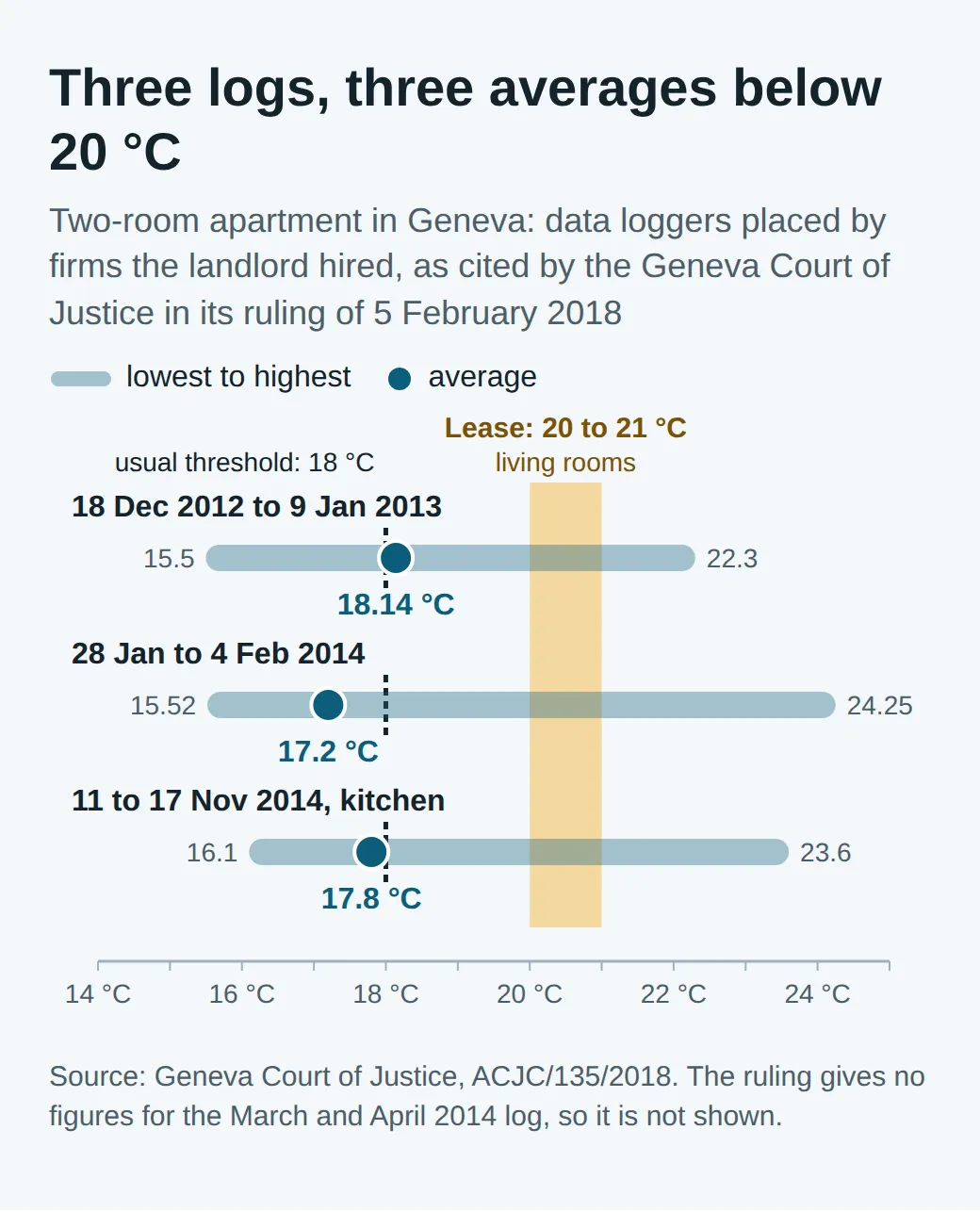
The highest readings top 22 °C every time, which shows the trap of a single measurement. And it happened: in March 2013, the management company's technician measured 23 °C at floor level and 22 °C on the walls and found the temperature acceptable, while noting 17 °C near the window. It was the averages, over one to three weeks, that convinced the judges.
After more than a year of repair visits that changed nothing, the tenant sent the landlord a formal notice by registered letter on 3 February 2014, with a deadline of 27 February. She paid all her rent on deposit from March 2014 and went to the conciliation authority on 28 March. The case lasted almost four years. The Geneva rental court (Tribunal des baux et loyers) first granted 10%. The Court of Justice doubled the reduction: 20% of the net rent of CHF 597 from 20 November 2012 to 16 November 2015, so CHF 119.40 a month, then 10% for as long as the defect remained. The reduction applied only to the heating period, from 1 October to 15 March each year.
The tenant won because she had figures. The tenants in the Vaud case had none.
How do you prove your apartment is too cold?
With dated measurements taken over several days. The counterexample is the 2011 Vaud ruling. In Pully, two tenants complain about the cold at night in a 3.5-room apartment rented for CHF 1,800 a month including service charges. Twice, the management company replies that it has received no exact temperature readings and that the complaint rests on a feeling. The tenants go round the building with a questionnaire, collect statements from neighbours and pay their rent on deposit. They lose on the heating: without readings, the witness statements reflect impressions rather than certainties, in the court's words, and they contradict each other.
The Geneva file shows the other difficulty. The heating firm put some sudden drops below 16 °C down to a logger moved close to a window, or to windows left open for a long time. A badly made log turns against you.
What makes your readings hard to challenge:
- a recording thermometer, which keeps the values day and night, rather than readings written down by hand;
- the device in the middle of the room, away from the window, the radiator and direct sun, always in the same spot;
- at least a week of readings in each affected room, windows closed, with that day's outdoor temperature;
- dated photos of the display and the radiators, and a copy of your readings with every letter you send.
First, check what is within your control. A neighbour in Pully admitted in court that she was sometimes cold at night, but had never tried adjusting the thermostatic valves on her radiators at night. Open them fully while you measure, and write that down. If your neighbours are cold too, a petition can help, but it is the witnesses who count. In Geneva, ten tenants had signed. The court relied on three of them, heard by the rental court, who confirmed the cold in their own homes. A fourth signatory admitted to the judge that she had no heating problem at all and had ticked the box to please her neighbour.
Once you have the figures, you need to put them in writing.
The letter to your landlord: what it must say
Write as soon as it is clear the cold is not going away. You have a duty to report defects you don't have to fix yourself, and the rent reduction only runs from the moment the landlord knows about the defect. A phone call to the caretaker leaves no trace: the Geneva tenant got her reduction from 20 November 2012, the day of her first letter.
If nothing changes, the second letter is the one that opens the way to paying rent on deposit. It must set a reasonable deadline for the repair in writing and announce that, failing that, you will deposit your future rent. The law puts no number on that deadline. In the Geneva rulings, the tenants allowed 24 days in one case and 9 days in the other, in the middle of summer. For heating that has broken down in January, a short deadline is easier to defend than for a setting that needs adjusting. Send it by registered post and keep a copy.
Subject: defective heating, formal notice. Since [date], the temperature in my apartment [address, floor] has been insufficient. My readings from [date] to [date], enclosed, give an average of [x] °C in the living room and [x] °C in the bedroom. I reported this defect to you on [date]. I set you a deadline of [date] to remedy it. Failing that, I will pay my future rent on deposit with the office designated by the canton. I reserve my right to a rent reduction from [date of first report] and to damages.
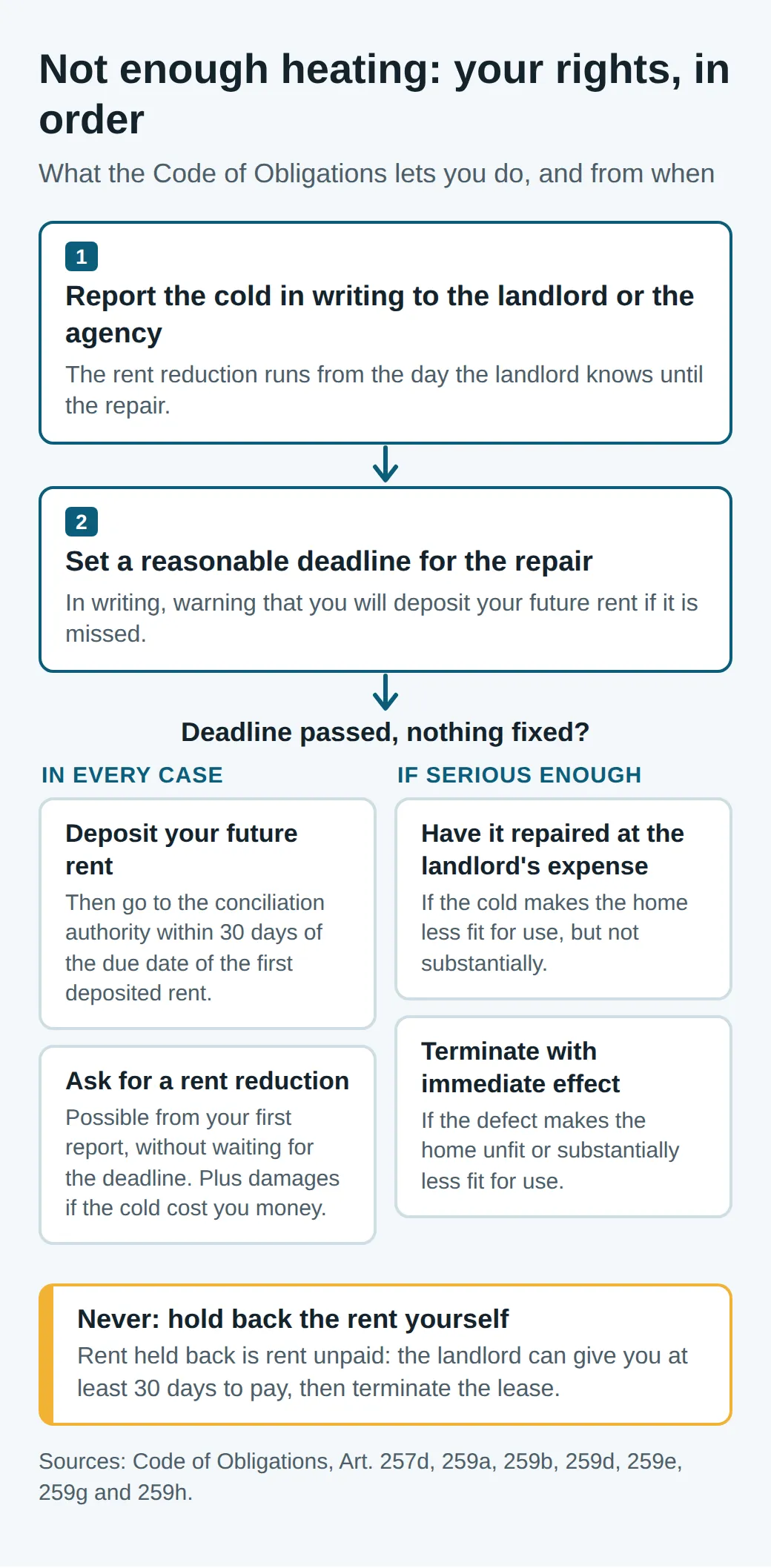
Two rarer rights exist if the deadline passes without a repair. If the cold makes the home less fit for use, but not substantially so, you can have it repaired at the landlord's expense. If it makes the home unfit or substantially less fit for use, you can terminate the lease with immediate effect. Both need a solid file, because you are the one who will have to prove the defect and how serious it is.
How much rent reduction for inadequate heating?
A reduction in proportion to the use you lose, worked out on the net rent, without service charges. The judge compares the apartment as it is with the apartment as it should be, and often decides on an equitable basis, with wide discretion. The Geneva rulings give a sense of the usual range. The Court of Justice notes that in past decisions it has granted 5 to 30% for insufficient heating.
In the 2018 case, the readings went as low as 15.5 °C, 4.5 °C below the 20 °C expected: the court called the sensation of cold significant and set 20%. When things improved without being solved, it cut the reduction to 10%. In the 2025 case, a new five-room apartment let for CHF 2,054 net, a firm had measured 17 °C in the tenants' home in February 2020. The rental court granted 10% from 1 October to 30 April, for the winters of 2018 to 2019 and 2019 to 2020, and the Court of Justice confirmed it.
The reduction isn't automatic. Ask for it in writing, stating the period. If the agency refuses, the conciliation authority decides. If the cold cost you money, say an electric heater and the bill that comes with it, add those costs: the landlord owes damages unless they can prove they were not at fault.
And if the agency still doesn't move, you can pay your rent on deposit.
Paying rent on deposit without falling into the traps
Paying rent on deposit means paying it to an office designated by the canton instead of to the landlord. This has nothing to do with your rental security deposit. The rent then counts as paid, but the landlord doesn't receive it until the dispute is settled. In Geneva, the office is the Financial Services of the judiciary. Their page on rent deposits describes three steps. You fill in a form and receive a deposit number starting with 14L. You pay the first rent with that number, then the next ones with the payment slips they send you. Finally, you file a request with the conciliation commission, the Commission de conciliation en matière de baux et loyers.

The first trap is that 30-day deadline. Federal law sets it for the whole country: if you don't bring your claims before the conciliation authority within 30 days of the due date of the first rent paid on deposit, the deposited rent goes to the landlord. That happened to the tenants in the 2025 Geneva case. They had paid on deposit from August 2020, didn't file their request in time, and the deposited rent was released to the landlord. They started again in January 2021, after a new formal notice.
The second trap: you can only deposit rent that is not yet due. A company renting a storage room in the canton of Basel-Stadt found that out before the Federal Supreme Court in 2021 (in German). Told to pay two months of arrears, it had deposited them instead: those payments did not count as paying the rent, and the termination of its lease for late payment stood. For the same reason, never keep the rent in your own account while you wait for the repair. Rent held back is rent unpaid: the landlord can give you a deadline to pay of at least 30 days, then terminate the lease.
In the canton of Vaud, we found no official page naming the office for rent deposits. In the Pully case, the tenants had opened a deposit account with the Banque Cantonale Vaudoise. Ask the prefecture of your district (in French) before you pay the first rent: it is also the body that then receives your application for conciliation.
Conciliation proceedings are free of court costs in tenancy disputes. The hearing takes place within two months, and where rent has been paid on deposit, the authority can make a decision proposal, which becomes final if nobody objects within 20 days. Our article on challenging your initial rent describes the application and the hearing in detail.
Can your landlord end your lease because you complained?
The landlord can try, but notice given because you are asserting your rights in good faith can be challenged. The Pully tenants went through exactly that: their ultimatum went out on 31 March 2010, and the management company terminated the lease on the official form on 1 April. The conciliation authority, then the rental court, set the notice aside as retaliation. Even so, they lost on the heating, for lack of readings.
So complaining in good faith protects you, even if you don't win on the defect itself. If you get notice after a complaint, challenge it within 30 days of receiving it, before the same conciliation authority.
What to do as soon as it turns cold
Start with a week of readings, valves open and windows closed, then write to the letting agency with your figures and the date of the first cold day. If it replies that everything "meets the standards", ask which ones, reread your lease and its annexes, and compare them with your readings. Set a deadline by registered letter before paying any rent on deposit, and put the 30th day after the due date of the first deposited rent in your calendar. If you are unsure, the conciliation authority in your canton is also there to advise both parties in tenancy matters.
And if you are looking for your next home before winter, ask at the viewing what heating system the building has, whether it is Minergie, and whether a brochure or house rules set any temperatures. Those are the documents a judge will read if your home is ever too cold. You will find listings in French-speaking Switzerland, for example in the canton of Vaud and in Geneva:
Common questions
Can my landlord turn the heating down at night?
No law forbids it. In a case from Pully decided in 2011, the system switched to a night setting of 16 °C from 11 pm to 4.30 am, and all eleven tenants who answered the management company turned down full heating at night. The court found that this setting did not prove the apartment fell below 18 °C, because the heat stored during the day escapes slowly. What counts is the temperature measured in your rooms.
Does my landlord have to pay for an electric heater I bought because of the cold?
If the cold is a defect, the landlord owes you damages for what it cost you, unless they prove they were not at fault. Keep the receipt for the heater and your electricity bills, and add the amount to your written claim or to your application for conciliation.
What if only one room in my apartment is too cold?
That can be enough. In the 2018 Geneva ruling, the last reading covered only the kitchen, which was below standard while the living room was found to be fine, and the court counted it among the evidence of the defect. The rent reduction will simply be smaller than if the whole apartment is cold, since it depends on how much of your use of the home is affected.
Can a Minergie apartment be kept cooler than a normal one?
Often a little, yes. In a case the Federal Supreme Court decided in 2017, the Geneva court had treated 20 to 21 °C as normal for an ordinary apartment and 19 to 20 °C for a Minergie one. Also read the documents that came with your lease: in Geneva, a Minergie brochure attached to the contract promised 20 to 21 °C in the living rooms, and that figure is the one that counted.
Do I get a rent reduction if the heating breaks down for two days?
Not necessarily. To count as a defect, a disturbance has to go beyond what a tenant must put up with, the Vaud Cantonal Court points out, and a breakdown fixed quickly can stay below that line. In the Pully case, a neighbour described two such breakdowns over the winter, at 18 °C by day and 16 °C at night, each fixed within two or three days. Still report every breakdown in writing: if they keep happening, you will have the dates.
More from the blog
All posts
Fixed-term lease in Switzerland: your rights and pitfalls
Fixed-term lease in Switzerland: how it ends without notice, tacit renewal, the 60-day extension deadline, leases the Federal Supreme Court made open-ended.

How to challenge your initial rent in Geneva and Vaud (2026)
Official form, 30-day deadline, real odds and the conciliation hearing: how to challenge your initial rent in Geneva and the canton of Vaud.
Lausanne housing cooperatives: how to join in 2026
Housing cooperatives in Lausanne or Geneva: who is eligible to join, what the cooperative shares cost and how the waiting lists work in 2026.