Fixed-term lease in Switzerland: your rights and pitfalls
What you need to know
A fixed-term lease ends by itself on the date written in the contract: no notice, no official form, and so no notice for you to challenge. You still have two protections: request an extension no later than 60 days before the end, and have the lease reclassified if the landlord chose a fixed term to stop you from defending your rights.
First, check that your lease really is fixed-term. Many contracts state a duration on the first page, one year or five years, then renew unless someone gives notice. In law, those are open-ended leases, with full protection against termination. This guide draws on the Code of Obligations and three Federal Supreme Court rulings, including that of a Geneva tenant who in 2019 got his four-year "fixed-term" lease turned into an ordinary one. We link the federal laws in English; the rulings, the cantonal texts and the legal study we cite are in French.
Fixed-term or open-ended: one test
What counts isn't the duration written in the lease but the way it ends. Under the Code of Obligations, leases have a limited duration "where the intention is that they should end without notice on expiry of the agreed duration". All other leases are deemed to be of indefinite duration. So when in doubt, open-ended wins.
Take the clause in Geneva's Règles et usages locatifs, the standard rental rules that apply to subsidised housing and to homes in development zones. Under them, the lease is concluded for an initial period of one year, then tacitly renewed on the terms in force for another year, and so on from year to year, unless either party gives notice at least three months in advance. It does have a first end date, but it only stops if someone gives notice. That makes it an open-ended lease: to end it, the landlord must give you notice on the canton's official form, and you can challenge it.
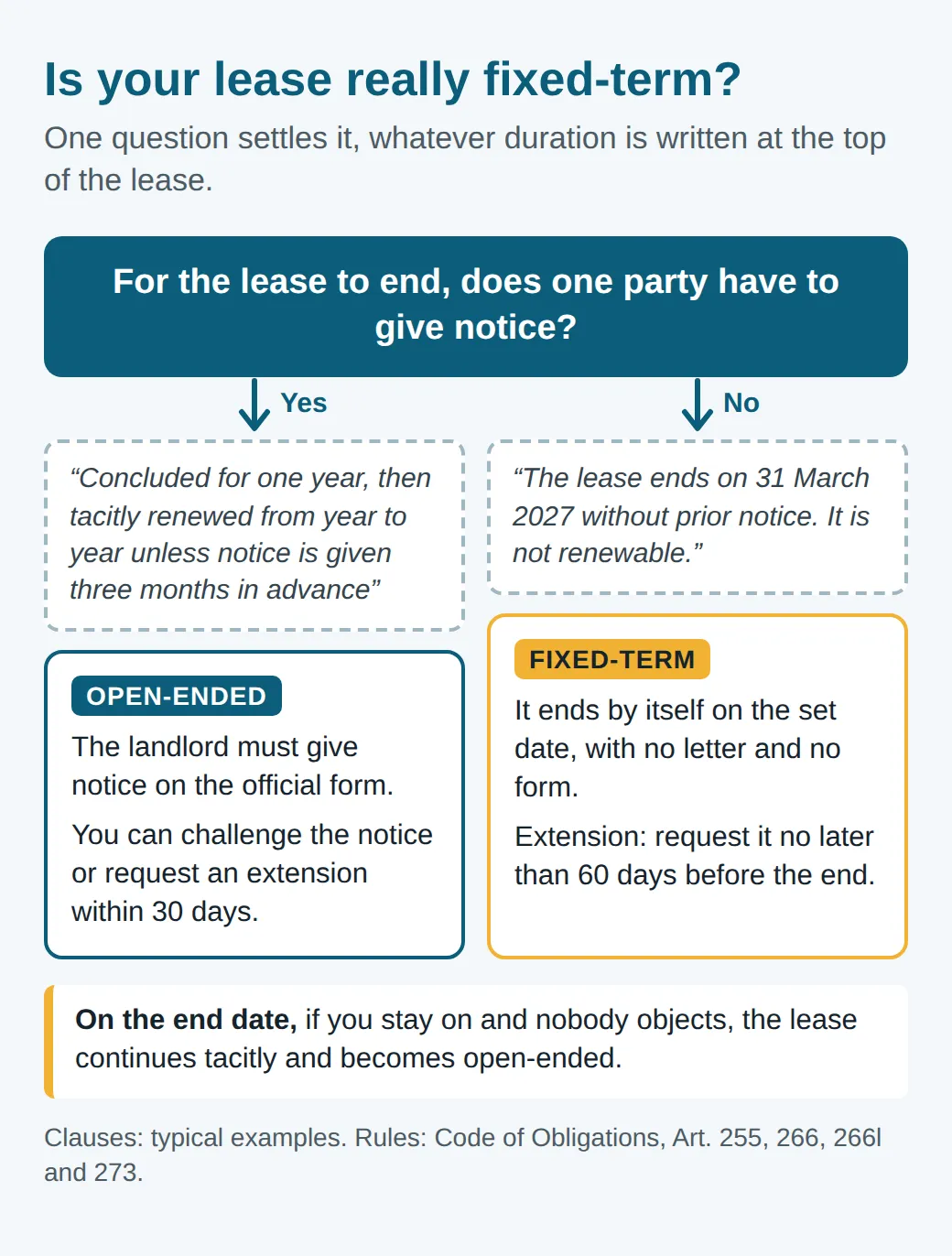
A lease is truly fixed-term when it says, in substance, that it ends "without prior notice" on a specific date, or that it can't be renewed. The duration is up to the parties and can be very long. The end can even depend on an event: a lease concluded until renovation work begins ends when the work starts, as Lausanne lawyer Carole Wahlen points out in a study published by the Séminaire sur le droit du bail of the University of Neuchâtel.
If your lease falls on the right-hand side of the diagram, the rest of this article is for you. Let's start with the day it ends.
What happens on the end date
Nothing, and that's exactly the risk. The lease expires that day with no letter, no form and no reason given. Since there's no notice, there's nothing to challenge within 30 days, and the rules against notice given in bad faith, for example because you asked for repairs, don't apply. The landlord is free not to offer you a new contract and doesn't have to say why. You hand back the keys on the agreed date, with a move-out inspection as for any other move.
One door stays open. If you stay on after the date and keep paying, and the landlord takes the money without a word, the lease is tacitly continued and becomes open-ended. The landlord then has to give you notice in due form, as for an ordinary lease. Don't build your plans on this rule: all it takes is for the landlord to remind you of the date or ask you to leave, and there's nothing tacit any more. They can then ask the court to evict you.
There's another scenario. A few months before the end, the agency offers you a new lease, often fixed-term as well, sometimes at a higher rent. That's a new contract, so you can challenge its rent as an initial rent, within 30 days. According to the case law Carole Wahlen cites, the deadline runs from the day you sign if you already live in the home. An increase of more than 10% on your previous rent is enough to open the challenge, even without a housing shortage. The conditions and the procedure are set out in our guide to challenging the initial rent.
Signing that new lease also means accepting a rent that won't move again, for better or worse.
During the lease, the rent stays put both ways
A fixed-term lease freezes the rent until the end. The law only lets the landlord raise the rent with effect from the next termination date, and a lease that ends without notice doesn't have one. The flip side is the same for you: a request for a rent reduction, for example after the reference interest rate falls, also takes effect from the next termination date. So during the fixed term it has no effect, as Carole Wahlen's study notes.
Two clauses are exceptions, and the law allows them only in long leases:
| Clause | Minimum lease term | What can change |
|---|---|---|
| None (fixed rent) | None | Nothing until the end |
| Stepped rent | 3 years | An increase in francs, at most once a year, set when you sign |
| Indexed rent | 5 years | The rent follows the Swiss consumer price index |
Stepped rent hides a trap. You can only challenge its steps together with the initial rent, within 30 days of getting the keys; during the lease, it's too late. A step planned for the fourth year therefore has to be disputed in the first month. Keep this rule in mind: it's at the heart of the Geneva case below.
A frozen rent protects you if the starting price is fair. If it isn't, time works against you, which is why the second date to remember is the end date.
Extension: the date to note when you sign
Even a fixed-term lease can be extended. The Code of Obligations lets you request an extension where the end of the lease would cause hardship for you or your family that the landlord's interests don't justify. The authority weighs up the circumstances: how the lease was concluded, its duration, your personal and financial situation, any need the landlord or their family has for the home, and the state of the local market. For a home, the extension can last up to four years, granted in one or two steps.
The deadline is the real difficulty. You must apply to the conciliation authority no later than 60 days before the lease expires. It's a strict deadline that the judge checks on their own initiative: once it has passed, there's no catching up. For a lease ending on 31 March 2027, counting back 60 days takes you to Saturday 30 January 2027. Don't leave it to the last day, let alone with a weekend in the way: file your request as soon as you know you won't find a new place in time.
Be realistic about the outcome. By signing for a limited period, you knew from the start that the lease would end. For that reason, says Carole Wahlen, the judge has to be restrictive, and a refusal or a short extension are both possible. Some cases are excluded by law, notably a lease expressly concluded until conversion or demolition work begins, or a lease terminated for late payment. If you get an extension of one year or less, you can leave earlier by giving one month's notice for the end of a month, so you can take a new place as soon as one comes up.
The request must be in writing and signed, and conciliation is free of charge in tenancy disputes. In Geneva, it goes to the Commission de conciliation en matière de baux et loyers, which offers a form headed "contestation de congé et/ou prolongation de bail" (challenging a notice or extending a lease). In the canton of Vaud, it goes to the prefecture of the district where the home is. Both authorities work in French. A few lines and your supporting documents are enough: you ask for a twelve-month extension of the lease on your apartment, give the address, the landlord and the end date, briefly explain your situation and list what you enclose. In French, it can look like this:
Je demande la prolongation du bail de l'appartement de 3 pièces situé [adresse], conclu avec [bailleur] jusqu'au 31 mars 2027, pour une durée de douze mois. Nos deux enfants sont scolarisés dans le quartier et nos recherches depuis septembre sont restées sans succès. Pièces : bail, liste des démarches, refus reçus.
An extension buys you time, not a home. To keep the apartment, you have to go after the fixed term itself.
When the court makes the lease open-ended
The landlord is entitled to offer a fixed-term lease without saying why. That right has a limit, which the Federal Supreme Court set in 2013 in ruling ATF 139 III 145: it's circumvention of the law when a landlord who really wants to let for an indefinite period chooses fixed-term leases solely to escape the mandatory rules that protect tenants. The court can then find that the lease is open-ended.
The Federal Supreme Court is blunt about why these leases suit some landlords. A tenant who hopes for a renewal thinks twice before challenging an unfair initial rent, asking for repairs or disputing a heating bill: the system pushes them to "se montrer docile", to keep quiet and comply. And since the 2019 Geneva ruling described below, circumvention can be found from the very first lease, not only after a series of contracts.
It's up to you to prove it, which means proving what the landlord intended. The Federal Supreme Court has taken that into account: if you describe the mechanism precisely, the court can settle for a high probability, what lawyers call a "preponderant likelihood", and ask the landlord to explain the choice. A housing shortage, a systematic practice by the landlord, the lack of any plausible reason and your own lack of interest in a limited term all count as evidence.
The Eaux-Vives apartment
In January 2016, a Geneva property agency confirmed to an applicant that it could let him a renovated 4.5-room apartment in Eaux-Vives, on a four-year "fixed-term" lease. After the renovation, Geneva's law on demolitions, conversions and renovations of housing (LDTR) put the rent under state control for three years. So the lease, signed on 11 October 2016, set the rent at 17,724 francs a year excluding charges for three years, then 34,800 francs in the fourth year, a rise of about 96%. It stated that it "s'éteint sans résiliation préalable le 31.10.2020", in other words that it would end without prior notice on 31 October 2020.
The tenant had been waiting a year for this apartment. He was living with his mother, was going through a separation and needed room to have his children stay. An agency employee had told him she'd often seen leases renewed, without promising anything. He moved in on 16 October and, nineteen days later, on 4 November, went to conciliation on two points: the rent and the duration.
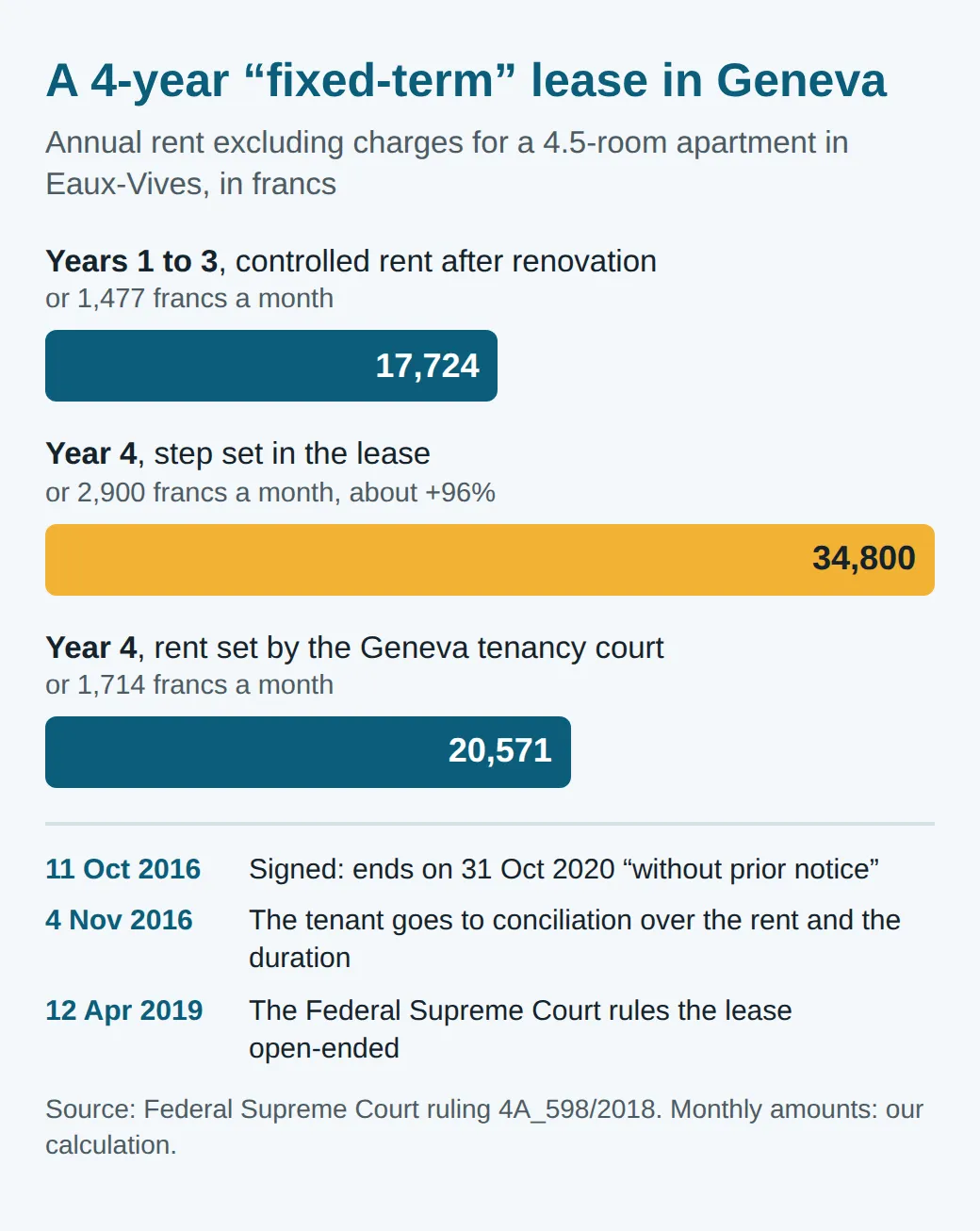
Geneva's tenancy court, the Tribunal des baux et loyers, found for him on both counts: it cut the fourth-year rent to 20,571 francs and declared the lease open-ended. The Cour de justice, the canton's appeal court, also found the step unfair but saw no circumvention in the duration. The Federal Supreme Court ruled on 12 April 2019. For years the agency had applied the same formula to its many homes under the LDTR: three years at the controlled rent, then one or two years at the market price. The landlord's lawyer had told the hearing there was "pas de motif", no reason, for the fixed term, since the law doesn't require one. And the tenant had no interest at all in a limited lease. He argued his appeal himself, without a lawyer.
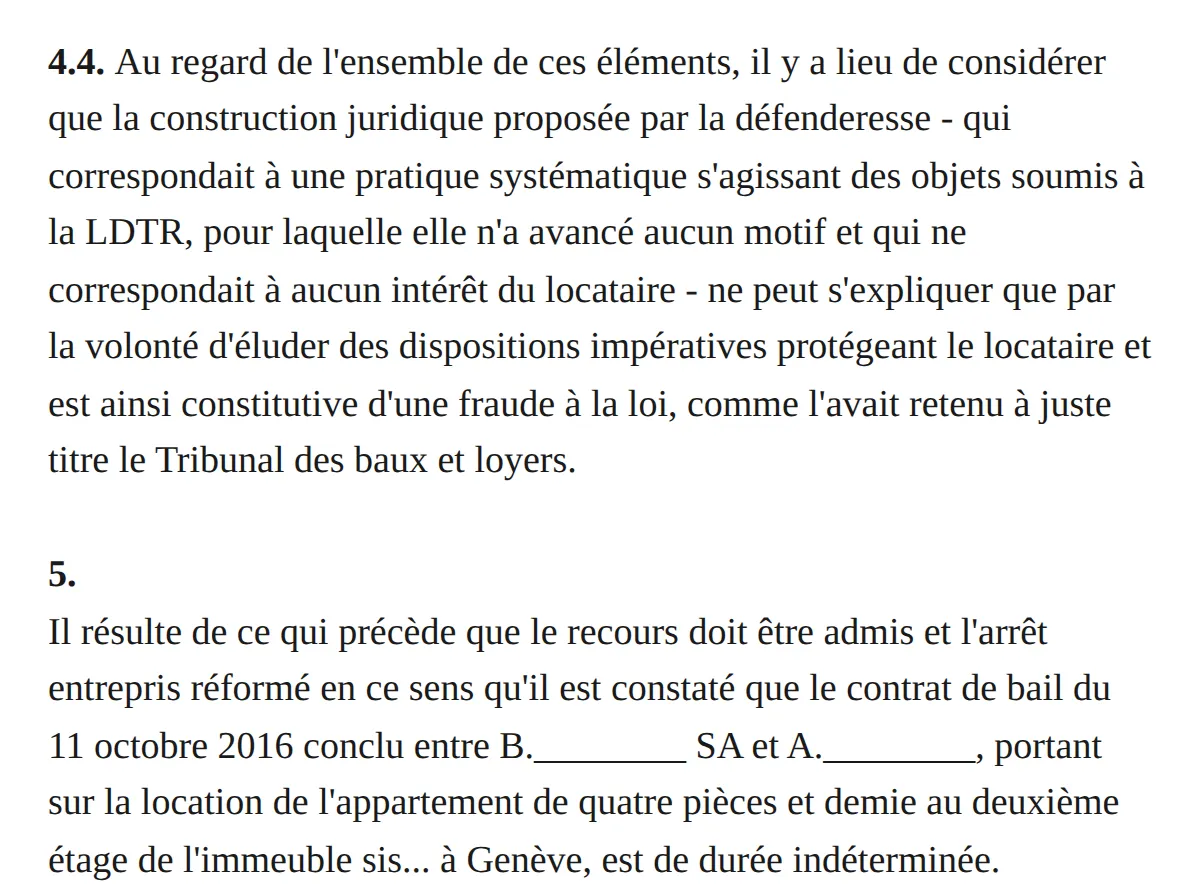
The Federal Supreme Court summed up the landlord's reckoning: if the tenant didn't challenge, it kept the higher rent; if he challenged and won, it only had to accept a fair rent until the fixed end date. Reclassifying the lease broke that calculation.
Two other rulings, two outcomes
A year earlier, the Federal Supreme Court had already left a reclassification in place in ruling 4A_48/2018. Two tenants had signed a lease for a 3.5-room apartment in central Geneva for twelve months and nine days, not renewable, at 2,290 francs a month plus advance payments for charges. The Geneva courts found that the landlord wanted to let for the long term but offered only fixed-term leases to deter its tenants from challenging their rent or a notice. Its appeal was declared inadmissible: the lease stayed open-ended, and the rent question went back to the tenancy court.
The 2013 ruling, by contrast, went against the tenants. They had signed one lease after another since 2004, but they had come from Spain on one-year employment contracts and had said they would have to return home: the short lease matched their situation. Legal commentators cite other reasons that look acceptable, such as a planned renovation, a worker posted for a limited period, students housed for one academic year, or an owner living abroad who wants their apartment back.
The risks a fixed term doesn't cover
A fixed-term lease doesn't protect you from a sale. If the building or the apartment changes hands, the lease passes to the buyer, but the buyer can terminate it for the next legal termination date if they urgently need the home for themselves or their close relatives. They must then respect the legal notice period, and the former landlord is liable for your loss if you have to leave earlier than the lease provided. Late payment or serious lack of consideration towards the neighbours also lets the landlord terminate before the end, after a written warning.
You're bound too. Unless a clause lets you leave early, you can't terminate before the date. Such clauses exist: in five-year indexed leases, Carole Wahlen notes, the landlord is bound for the whole term but the tenant can usually leave every year. Without a clause, you have to put forward a solvent replacement tenant who is willing to take over the lease on the same terms; otherwise you owe the rent until the end. Good cause, meaning an event you couldn't foresee when you signed, that isn't your fault and that makes the lease unbearable, lets you leave with the legal notice period, but the court may order you to compensate the landlord.
Finally, a holiday rental of three months or less falls entirely outside these protections. Beyond that, a furnished apartment let for a few months is a residential lease like any other.
Not everything works against you, though. During the fixed term, the landlord can neither give you ordinary notice nor raise the rent beyond what the lease provides. For a family that wants to stay three years near a school, a three-year lease at the right price offers real security.
Before you sign a fixed-term lease
First ask the diagram's question: does this lease need notice to end? If the answer is no, ask the agency in writing why it's offering a limited term, and keep the answer, the listing and the emails. In the Eaux-Vives case, what the agency employee and the landlord's lawyer said carried a lot of weight. Then put two dates in your calendar: the 30th day after you get the keys, to challenge the initial rent and any steps, and the 60th day before the end, to request an extension.
If you want to settle in for the long term, favour listings that offer an ordinary, renewable lease, and read the duration clause before the viewing rather than when you sign. In Geneva, where vacant homes are scarce, our guide to finding an apartment in Geneva helps you organise the search. Current listings in the cantons of Geneva and Vaud:
Common questions
Can a fixed-term lease be ended early by mutual agreement?
Yes. You and the landlord can agree on a moving-out date at any time, with no notice period or termination date to respect. The law requires no particular form, but put the agreement in writing and have both of you sign it. Also set out what happens to the rent, the rent deposit and the move-out inspection.
Can a co-tenant or a spouse request a lease extension on their own?
If the apartment is the family home, the tenant's spouse or registered partner can request an extension even without having signed the lease. Between co-tenants, legal commentators accept that one signatory can act alone, provided the request also names as respondents the co-tenants who don't want to take part. In both cases, the deadline of 60 days before the end stays the same.
What happens if you stay after a fixed-term lease ends without the landlord's agreement?
If the landlord doesn't tacitly let you carry on, they can ask the court to evict you. A request for an extension filed in time, on the other hand, lets you stay while the proceedings run, as long as the period you asked for hasn't passed.
Is the rent deposit different for a fixed-term lease?
No. For a home, it's capped at three months' rent and must be paid into a bank account in your name. The bank only releases it with both parties' agreement, on a court judgment, or on a payment order you didn't object to. If the landlord has started neither a court case nor debt collection within a year of the end of the lease, you can claim it back on your own.
More from the blog
All posts
Apartment too cold in Switzerland? Minimum temperature rules
No legal minimum in Switzerland: the 18 °C and 20 to 21 °C court thresholds, proving the cold, writing to the landlord, rent reduction, rent on deposit.
How to challenge your initial rent in Geneva and Vaud (2026)
Official form, 30-day deadline, real odds and the conciliation hearing: how to challenge your initial rent in Geneva and the canton of Vaud.
Lausanne housing cooperatives: how to join in 2026
Housing cooperatives in Lausanne or Geneva: who is eligible to join, what the cooperative shares cost and how the waiting lists work in 2026.