Lausanne housing cooperatives: how to join in 2026
The essentials first
To get into a housing cooperative in Lausanne or Geneva, you first join, for anything from a few dozen to a few hundred francs depending on the cooperative, and then you wait your turn: Codha talks of 3 to 7 years. When you sign the lease, you pay for cooperative shares, from a few thousand francs to more than CHF 20,000. And Lausanne's largest cooperative, SCHL, hardly takes any new members.
There is no shared list and no single office to apply to: each cooperative sets its own entry price and its own way of ranking applicants. We read the rules published by six cooperatives and the pages of the canton of Geneva and the City of Lausanne to tell you who will take you today, how much you'll pay and how your place in the queue is worked out. Most of these sources are only available in French.
What a cooperative lease changes
You are both a tenant and a co-owner. The cooperative owns the building; you rent your apartment, but your shares make you a member, with one vote at the general meeting however much you paid in. The rent covers the costs, with no profit margin for a landlord.
Two advantages become clear over time. First the rent: in its FAQ, the umbrella group of Geneva's housing cooperatives (Groupement des coopératives d'habitation genevoises, GCHG) says cooperative homes cost about 20% less than those of other landlords, and a little further down the same page gives 30%. Take that as a rough guide, not a measurement. ARMOUP, which brings together non-profit housing developers in French-speaking Switzerland, adds a useful caveat: a new cooperative building isn't necessarily cheap on day one. It becomes cheaper over the years, as the loans are paid off. Then security: according to the canton of Geneva, a cooperative doesn't end a lease without first expelling the member from the cooperative.
The price of these advantages is access: apartments rarely become available, and each cooperative alone decides who goes first.
There is no shared waiting list
You sign up cooperative by cooperative. In Geneva, the GCHG says so plainly in the same FAQ: it builds nothing, lets nothing and keeps no waiting list. It points you to its 73 member cooperatives, 21 of which describe themselves as participatory, and notes that some of them have long lists.
The canton of Geneva sums up the two ways in on its registration page. With a traditional cooperative, you apply for an apartment and become a member when it is allocated to you. With a so-called participatory cooperative, you become a member first, and that share gets you onto a waiting list, nothing more. The canton is clear: buying shares is not enough to get an apartment.
In Lausanne, the City doesn't keep a list of cooperatives. The most useful page is the one on the Plaines-du-Loup eco-district, which gives the contact and category of each building: SCHL, Codha, Ecopolis, Le Bled, La Meute, Logement Idéal and the Cité Derrière cooperative sit alongside SILL and private investors. Let's start with the largest, because it's often the first one people look for, and the hardest to get into.
SCHL: the largest, and nearly closed
The Société Coopérative d'Habitation Lausanne no longer takes new members, with two exceptions. Founded in 1920, it had 8,331 members and 2,497 apartments at 31 December 2025, 243 of them subsidised, in 103 buildings. To get on its waiting list, you have to be a member. But membership is reserved for members' children: that's the first exception.
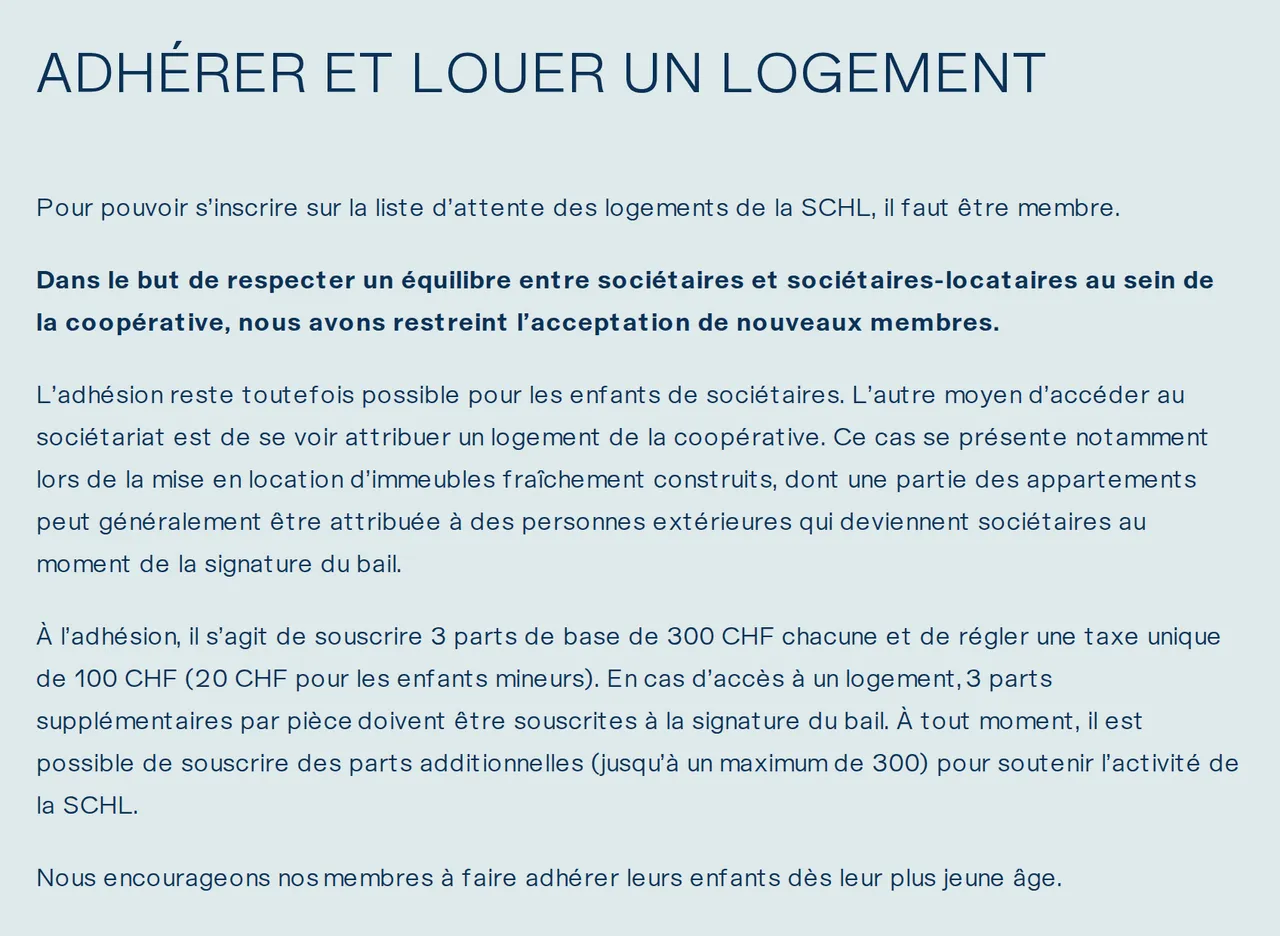
The second exception matters if you're coming from outside: you also become a member when SCHL allocates you an apartment, above all when a new building is first let. In the cooperative's 2025 annual report, its chair writes that members often take no more than half of the newly built apartments. The rest go to outsiders, who become members when they sign the lease.
The same report counts 152 apartments under construction, 105 of them on rue de la Borde and rue des Crêtes in Lausanne and 47 in Bussigny. SCHL advises checking its page of available apartments 3 to 4 months before a new building is let. Its subsidised apartments are only offered through these listings. One detail that rules some applicants out: dogs aren't allowed in its apartments.
In the existing buildings, turnover stays low: the 2025 report counts 162 changes of tenant, a turnover rate of 6.65%. For members, a formula decides the order.
How SCHL ranks you
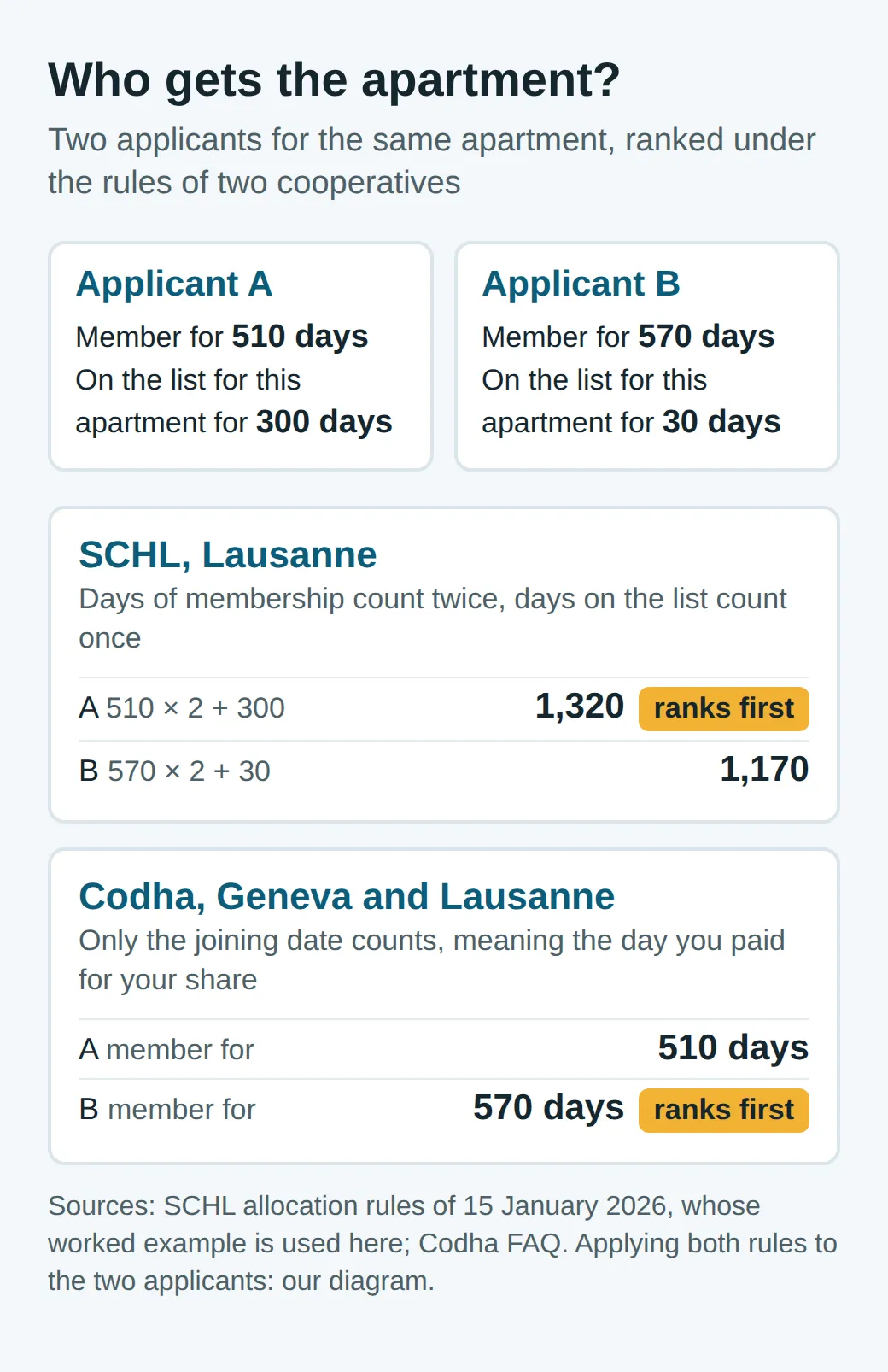
Your rank depends on two periods, counted in days. The allocation rules adopted on 15 January 2026 give two thirds of the weight to how long you've been a member and one third to how long you've been on the list. In practice, each day of membership is worth two points and each day on the list one point. Your registration is valid for one year, so remember to renew it on the members' online portal.
The rules also set a minimum number of occupants: 2 people for a 3-room apartment, 4 for a 4-room one (3 for a single-parent family or shared custody), and 5 for 5 rooms or more. Management can also put certain households first: families with children for 3-room apartments, households with a member aged 65 or over for apartments adapted to older people, and cooperative tenants who want to move somewhere smaller. Finally, if no member comes forward for a vacant apartment, SCHL can let it to an outsider, who joins before signing.
So unless you're a member's child, your chance at SCHL is a new building. To start building up seniority right now, you need to look elsewhere.
Cooperatives that will take you today
Several cooperatives active in Lausanne and Geneva accept any adult. At Codha and at Le Bled, the date of your first payment starts a clock, and that clock is what will put you ahead of others. So the sooner the better, even if you don't plan to move for several years.
| Cooperative | To join | Every year | Who can join |
|---|---|---|---|
| Codha (Geneva, Lausanne) | 1 share of CHF 100 | CHF 140 (CHF 200 for 2 people) | Any adult |
| Le Bled (Lausanne) | 1 share of CHF 100, or the fee alone | CHF 20 | Anyone aged 18 or over |
| Équilibre (Geneva) | 1 share of CHF 500 | CHF 125 | One intake a year, in spring |
| SCHL (Lausanne) | 3 shares of CHF 300 plus a CHF 100 fee | Not stated | Members' children, or people allocated an apartment |
Codha, founded in Geneva in 1994 and also present in Lausanne, looks at one thing only: seniority, counted from the day you pay your CHF 100 share. When an apartment becomes available or a new building is in preparation, every member gets an email and has roughly two to four weeks to apply. The cooperative then sorts the applicants by seniority and picks the longest-standing members as future residents, for about 70 to 80% of the planned apartments. The next in line form a waiting list, which isn't reopened until it has run out. Its FAQ puts the wait at 3 to 7 years after you join, and warns that Codha is not a solution if you need a home urgently.
Le Bled, a residents' cooperative in the Plaines-du-Loup, lets you answer its calls for applications once you pay its supporting fee of CHF 20 a year. For allocation, what counts is the date of your first payment, not the date you signed up, along with how long you've paid in. Its neighbour Ecopolis is taking new members after a meeting, and expects real involvement from them.
In Geneva, Équilibre admits new members only once a year: a request sent after 31 January is dealt with the following year. You then attend an information session and the spring general meeting, and pay by 30 June. Another example of a timetable you don't control: the Société Coopérative d'Habitation Genève, with nearly 2,000 apartments, had temporarily closed registrations in mid-October 2026 to process the applications it had received.
These sums are small, but the fee is paid every year: for a single person, five years at Codha comes to CHF 700 before you even have an apartment. And the clock doesn't tell you how many people are waiting ahead of you.
Members versus apartments: why the wait is so long
There are far more members than apartments. SCHL and Codha each have just over 8,000 members, but very different numbers of homes.
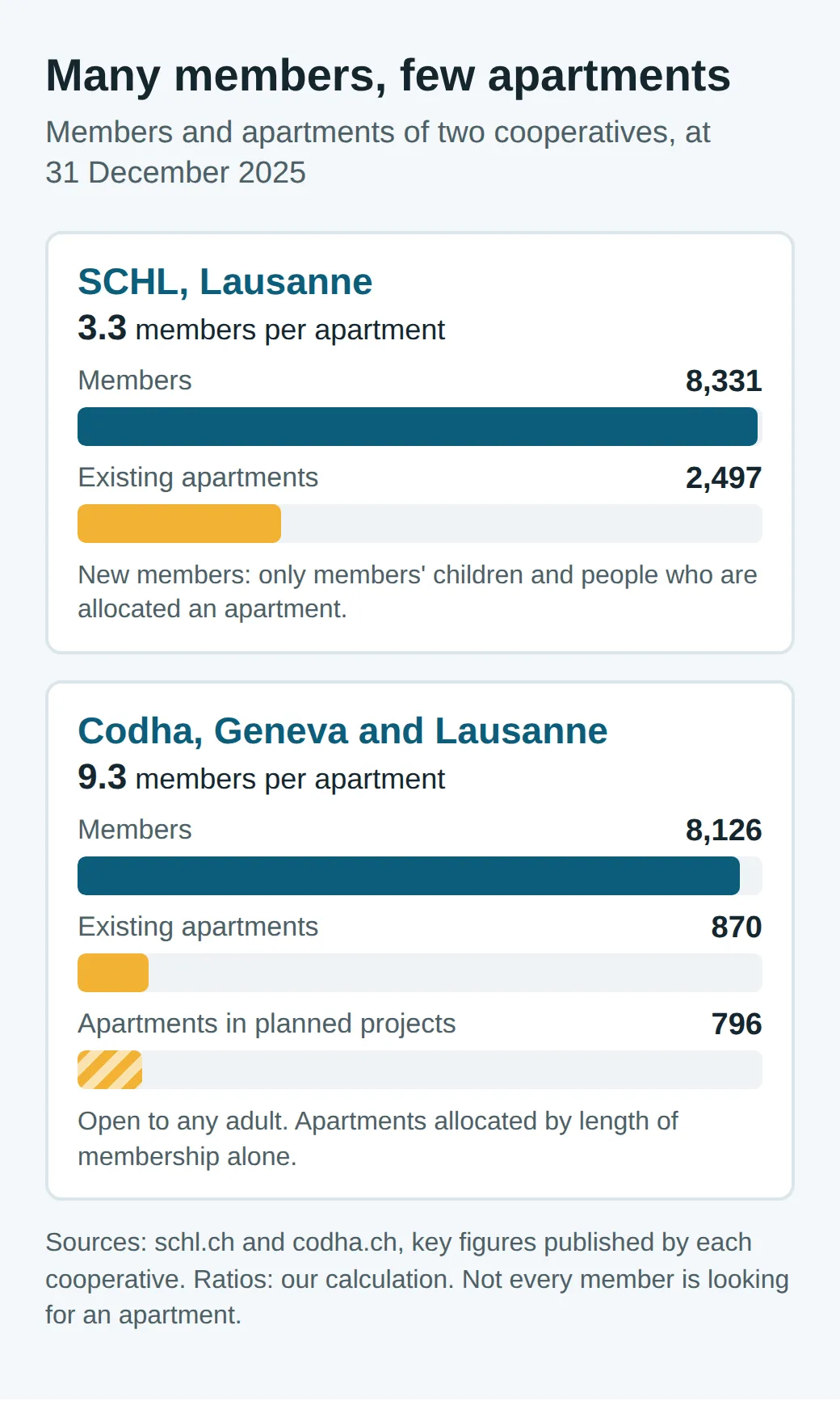
At Codha, 8,126 members, in 6,075 households, share 870 existing apartments. Not all of them are looking for a home, and some already live in one, but 9 members per apartment explains the years of waiting. The figure that matters to you is the 796 apartments in planned projects: each new building opens a call, and your seniority on that day decides.
At SCHL, the ratio looks better on paper, at 3.3 members per apartment, but the door is closed to outside adults. Both figures say the same thing: you don't find a cooperative apartment in a few months, you prepare for it. Part of that preparation is financial.
What cooperative shares cost when you sign
The real money comes when you sign the lease. The shares usually replace the rent deposit and are refunded when you leave, but you have to pay for them up front. According to the canton of Geneva, members generally put in 5 to 10% of the value of their apartment. Yet the gaps between cooperatives are huge.
At SCHL, the calculation is simple: on top of the 3 basic shares, you buy 3 shares of CHF 300 per room. For a 4-room apartment, that's 12 more shares, so CHF 4,500 in shares in total, plus the CHF 100 entry fee. Its key figures for the end of 2025 even show a return of 2.50% on the shares.
At Codha, the shares paid by residents serve as equity to secure the bank loan for each building. The cooperative counts CHF 5,000 to 6,000 per room, kitchen included, so CHF 20,000 to 24,000 for a 4-room apartment in Geneva. In the canton of Vaud, the kitchen isn't counted as a room, so a Vaud 4-room apartment has five rooms by Codha's count, and our calculation gives CHF 25,000 to 30,000. These shares earn no interest. Part of the amount is due as soon as you're allocated an apartment in a building under construction, and paying in instalments is sometimes possible.
For comparison: on the open market, a rent deposit is capped at three months' rent. If the sum looks out of reach, there are two ways to cover it.
Paying with your second pillar
You can withdraw money from your pension fund to buy shares in a housing cooperative. The federal ordinance on home ownership through occupational pensions (in French) expressly allows it, and the CHF 20,000 minimum for an early withdrawal doesn't apply in this case. There are two conditions: you must live in the apartment yourself, and the shares are deposited with your pension fund until they're refunded. When you leave the cooperative, the money is transferred to a pension fund or to another cooperative whose apartment you live in, not paid into your account. Codha says you make the request when the apartment is allocated to you. Before you sign, ask your pension fund how the withdrawal affects your benefits.
In Geneva, a loan from the canton
The canton of Geneva lends the money for the shares to households for whom they are too heavy a burden. The cooperative member's loan is repaid within 5 years at most, in fixed monthly instalments, at the average interest rate on the canton's debt. You must stay under an income ceiling and have no assets as defined by the cantonal regulation. The burden counts as too heavy when the rent exceeds a set share of household income, for example 27.3% if the apartment has one room more than the number of occupants. You apply to the cantonal housing office (Office cantonal du logement et de la planification foncière), with the cooperative's written offer of an apartment.
Money isn't everything. In some cooperative apartments, other conditions are added to the cooperative's own.
When the apartment is subsidised, other rules apply
A cooperative apartment can be subsidised or rent-capped, and then the public rules come before the cooperative's. In Lausanne, moderate-rent housing (logement à loyer modéré, LLM, formerly called subsidised housing) requires you to be Swiss or to hold a B, C or F permit, and to have lived or worked in Lausanne for at least 3 years without a break. The City's housing office then checks your income and household size. For affordable-rent housing (logement à loyer abordable, LLA), aimed at the middle class and common in the Plaines-du-Loup, the City asks for 2 years of living or working in Lausanne and a number of rooms that fits the household.
In Geneva, a subsidised cooperative apartment (HBM, HLM or HM) follows the cantonal rules, including the residence requirement we cover in our article on finding an apartment in Geneva. You apply through the letting agency that publishes the listing, or through the secretariat of the public-law housing foundations (SFIDP). Codha then applies Geneva's occupancy rule: at most 2 rooms more than the number of residents, kitchen included. In the canton of Vaud, it allows 1 room more than the number of residents. So a couple without children won't be given a 5-room apartment, even at the top of the list.
These rules follow the apartment, not the cooperative: in a subsidised apartment, a rising income can cost you the right to stay. SCHL notes in its 2025 report that the tenants of Valency, an estate that left the subsidised scheme after renovation, can now stay whatever their income.
Geneva wants to double the share of cooperatives
Geneva is where supply should grow most. A census the canton published in 2022 counted 128 cooperatives at the end of 2021, owning nearly 12,000 homes, about 5% of all homes in the canton. On 28 September 2025, Geneva voters approved the initiative «Pour + de logements en coopérative» (for more cooperative housing) by 67,897 votes to 44,485, or 60.4% of valid votes. Its goal: 10% of the housing stock in cooperative hands by 2030, which the canton put in 2022 at about 10,000 extra homes.
For you, that means more calls for applications, and members who are already signed up will benefit first. The GCHG held open days at Geneva's cooperatives from 3 to 6 July 2026: when they come round again, they're a good chance to see the buildings before choosing where to sign up.
In Lausanne, growth comes through land owned by the City: alongside partners such as the Fondation Pro Habitat Lausanne, SCHL has won a plot for about 55 apartments in the second phase of the Plaines-du-Loup. There too, members will go first, and outsiders will share what's left.
Where to start
Start with the clock, not the apartment. Pick one or two open cooperatives whose buildings appeal to you, and pay your first share now: at Codha and at Le Bled, the date of that payment is what will count on the day of a call. Put the renewal of each registration in your diary, and for Équilibre, the 31 January deadline.
At the same time, watch for new buildings, the only door SCHL leaves open to outsiders. Set aside the money for the shares, or check with your pension fund: CHF 4,500 for a 4-room apartment at SCHL, more like CHF 20,000 to 30,000 for a 4-room apartment at Codha, depending on the canton. If you're aiming for subsidised housing in Lausanne, count your years of living or working in the city.
And since the wait is counted in years, keep searching the open market. Our article on rents in Lausanne helps you judge a listing, and if you're studying, the one on student housing describes the residences and their waiting times. Current listings in Lausanne and Geneva:
Common questions
Can you join more than one housing cooperative at the same time?
Yes. Nothing in the rules we read forbids it, and it's a way to improve your chances. Each cooperative keeps its own list and counts your seniority from its own date. At Codha, you can't be a future resident of two projects at once, but you can stay on the waiting list for a second one.
Do you get your cooperative shares back when you leave?
Yes, as a rule at their nominal value, meaning the amount you paid in, with no gain. Codha says it refunds the share as long as your fees are paid up. If you paid with money from your second pillar, it goes back to a pension fund or to another cooperative, not into your bank account.
Do you have to move out of a cooperative apartment if your income goes up?
In principle, no, if the cooperative apartment isn't subsidised: ARMOUP, the association of non-profit housing developers in French-speaking Switzerland, writes that expelling a member because their income changed would go against the cooperative spirit. In subsidised housing it's different: in Lausanne, LLM tenants are checked regularly and must meet the conditions until the end of the lease.
Can you join a housing cooperative with a B permit from outside Europe?
Ask each cooperative before you pay, because the rules are changing. Codha writes that membership for B permit holders from outside Europe has been approved at federal level, and that until this directive is applied, it accepts them on the basis of the annual fee alone.
Do you pay a rent deposit in a housing cooperative?
Usually not: the cooperative shares take its place, as ARMOUP explains. But check each case. In the buildings SCHL manages for other owners, such as those of the Fondation Pro Habitat Lausanne, an ordinary deposit of three months' net rent is required.
More from the blog
All posts
Move-out inspection in Switzerland: wear and tear or damage?
Normal wear and tear, item lifespans, the landlord's deadline, free conciliation: what you really pay at a move-out inspection in French-speaking Switzerland.

Average rent in Lausanne: 2024 figures by number of rooms
Average rent in Lausanne by number of rooms, for new and older leases, by neighbourhood and in nearby towns, from FSO and Statistique Vaud figures.

Finding an apartment in Geneva in 2026: a realistic guide
Only 0.31% of homes are vacant. How to find an apartment in Geneva in 2026: letting agencies, your application, HBM and HLM, City housing, scams and timing.