Student housing in Lausanne: FMEL rents and 2026 deadlines

Before you start looking
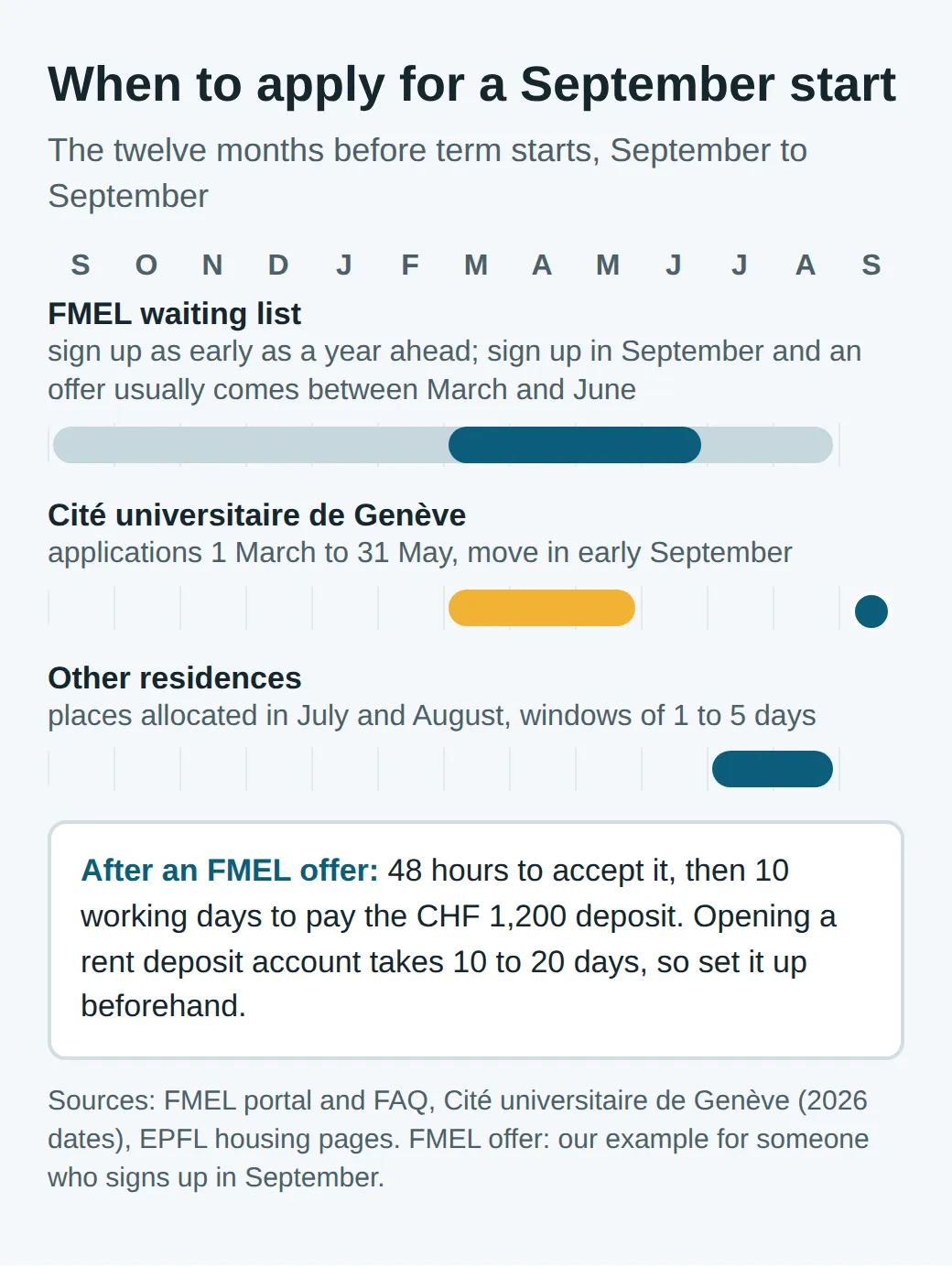
Student housing in Lausanne costs CHF 510 to 1,200 a month at the FMEL, the region's big student housing foundation, with utilities and internet included, and CHF 550 to 915 at the FSLE. The real hurdle is the wait: the FMEL usually puts it at 6 to 9 months. Sign up as soon as your study plans are settled, up to a year ahead.
Below is what the foundations publish themselves, house by house: the rents, what comes on top, what you pay before you get the keys, and the timetable that goes with it. Geneva's Cité universitaire runs on its own dates, which we give further down. If no residence comes through in time, a flatshare or a room in someone's home are the two ways out, each with its own pitfalls.
How much does student housing cost in Lausanne?
A room in a student residence costs CHF 510 to 1,070 a month, a studio CHF 670 to 1,200. These are all-in rents: at the FMEL they cover internet, water, electricity, heating, building upkeep, and fire, liability and burglary insurance, according to each house's page on fmel.ch. Everything comes furnished, but without sheets, a duvet or crockery.
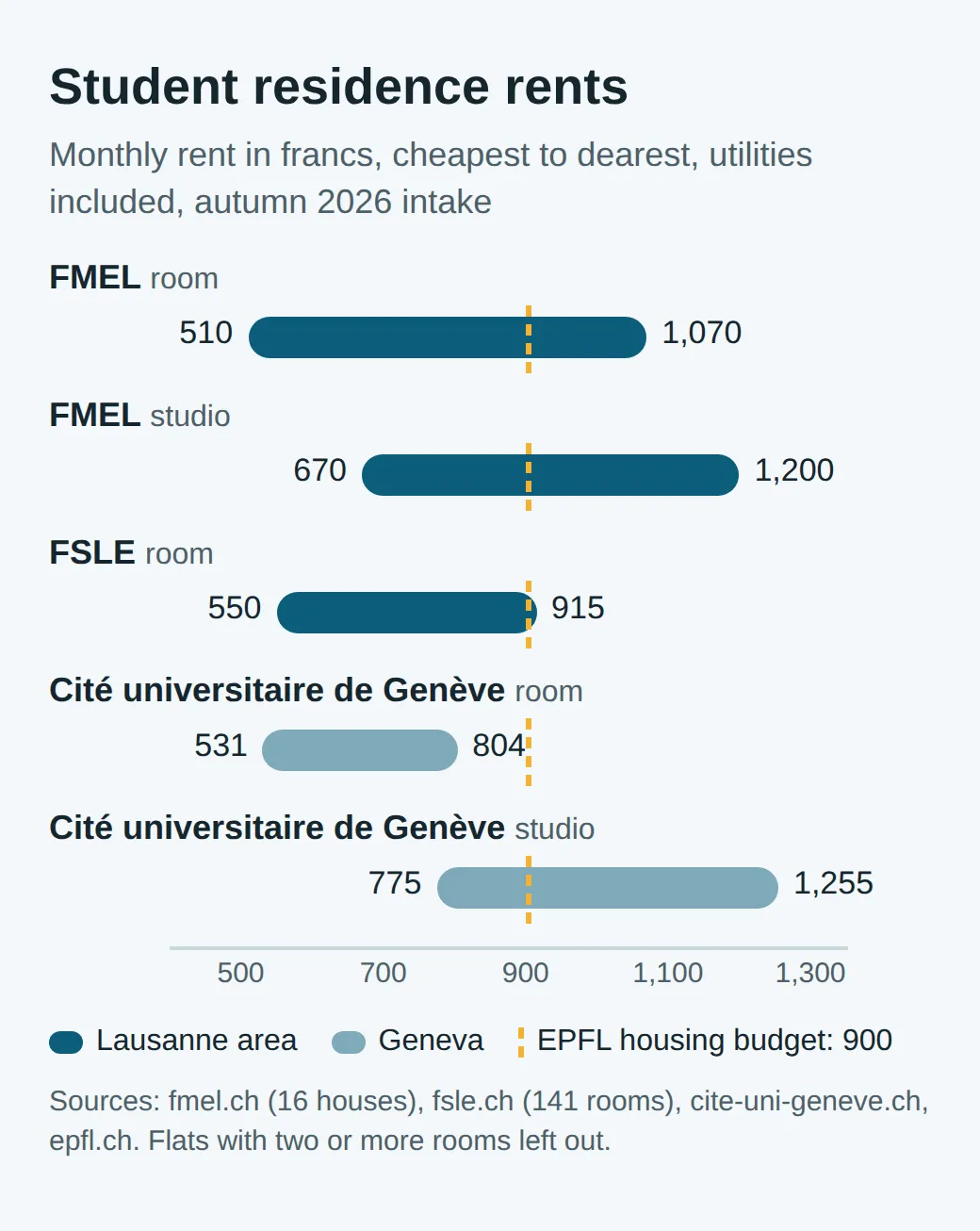
As a benchmark, EPFL allows CHF 900 a month for housing in its sample student budget, out of a total of CHF 2,393 for a Swiss resident and CHF 2,107 for an international student, tuition fees not included. Most foundation rooms come in under that line. The private market is another story: the UNIL and EPFL housing portal already recorded an average room rent of CHF 775 in 2020, and notes that it has been rising for several years. For flats, our article on rents in Lausanne has the figures.
Within the FMEL, the spread is wide: CHF 510 for a room in six houses, over CHF 1,000 for some flatshares at Vortex. The table below lists each house's rents in francs a month.
| House | Hub, municipality | Room | Studio |
|---|---|---|---|
| Bourdonnette | Santé, Lausanne | 510 | 670 |
| Cèdres | Ville, Lausanne | 510 to 530 | 670 |
| Falaises | Ville, Lausanne | 510 to 530 | 670 to 750 |
| Ochettes | UNIL, Chavannes-près-Renens | 510 | 750 |
| Triaudes | EPFL, Ecublens | 510 | 750 |
| Marcolet | Village, Crissier | 510 | 750 |
| Rhodanie | Ville, Lausanne | 530 | 750 |
| Stähli | Village, Yverdon-les-Bains | 600 | 800 |
| Square | Ville, Lausanne | 630 | 800 to 830 |
| Rainbow | Village, Echandens | 630 | 830 |
| Planète Bleue | Ville, Lausanne | 665 to 890 | none |
| Jordils | Village, Echandens | 720 | 960 |
| Atrium | EPFL, Ecublens | 740 | 950 |
| Neostar | Santé, Chavannes-près-Renens | 750 | 950 to 1,200 |
| Vortex | UNIL, Chavannes-près-Renens | 760 to 1,070 | 960 to 980 |
| Azur | EPFL, Saint-Sulpice | none | 930 to 960 |
One thing before you set your heart on a particular house: you don't get to choose it, and the way the FMEL allocates its rooms explains why.
How does the FMEL work?
The FMEL allocates its housing by computer, based on the preferences you enter on its portal: the start and end dates of the lease, the type of housing and your budget. Its FAQ is clear on this: you choose neither the house nor your flatmates. Your budget therefore works as a filter. With a ceiling of CHF 550, only the houses at the top of the table are in play; at CHF 800, almost all of them are.
The foundation, set up in 1961 by the City of Lausanne, the Canton of Vaud and the University of Lausanne, lists 4,969 beds in 16 houses. It houses bachelor's and master's students at the Vaud universities and colleges listed on its booking page, including UNIL, EPFL, ECAL and HEIG-VD. Doctoral students, apprentices, students in a preparatory year and anyone who already holds a master's degree are not eligible.
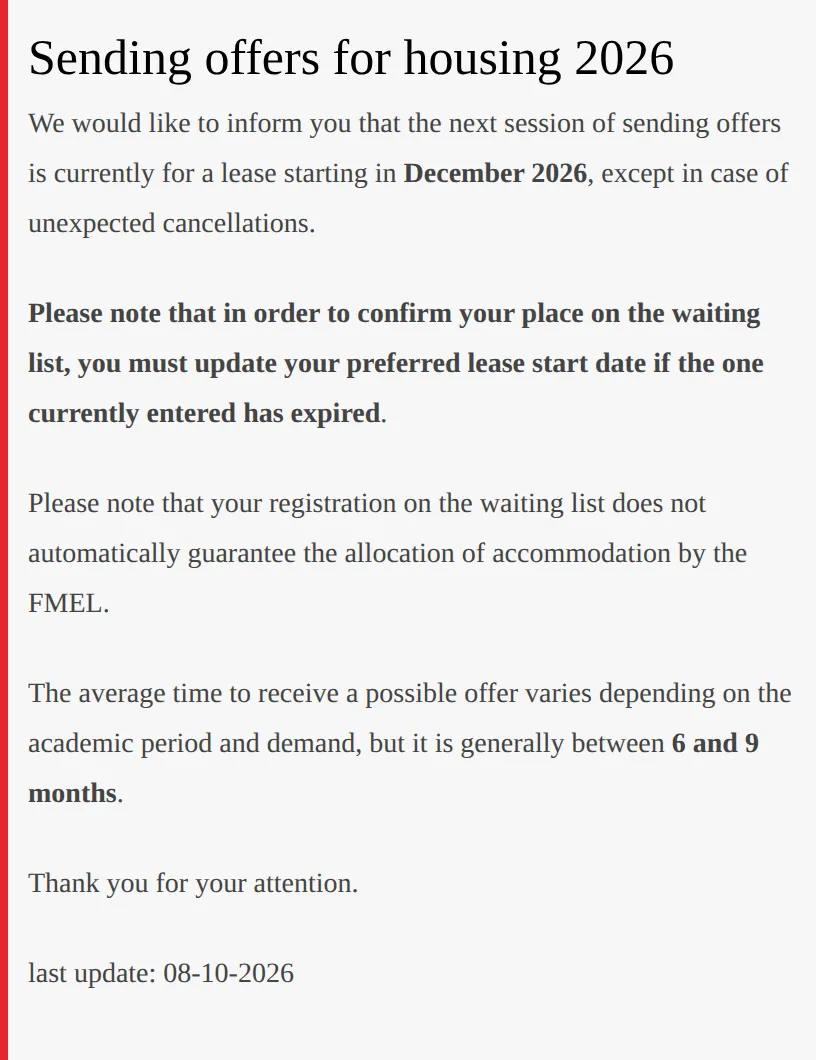
A waiting list of 6 to 9 months
You join a waiting list, and the FMEL then sends out offers in rounds. Its portal spells it out: the average time to receive an offer "is generally between 6 and 9 months", and signing up does not guarantee you a place.
The same portal explains why. The FMEL grew from about 1,300 units in 2013 to about 4,000 in 2024, but a lease can run for three years, so few rooms come free each year. On top of that, a quota set by the agreement between UNIL, EPFL and the FMEL is reserved for certain students: those on exchange programmes, those coming from German-speaking Switzerland and holders of excellence scholarships. These rooms don't go through the portal. If you fall into one of these groups, contact your university's housing service first.
The new Neostar house, on the Campus Santé in Chavannes-près-Renens, welcomed its first students in September 2026; the FMEL says it has room for 776 students. It doesn't change the rules of the game: you still sign up early. One detail matters too. If the lease start date you entered has passed, your place on the list is only confirmed once you update it.
An offer, then 48 hours
When an offer arrives by email, you have 48 hours to accept it, or it lapses. After that, the CHF 1,200 deposit has to be paid within 10 working days into a rent deposit account at a bank. The FMEL warns that opening this account takes 10 to 20 days, that you can't move in without the bank's confirmation, and that it doesn't accept SwissCaution or similar deposit insurers. Talk to your bank before the summer, not on the day the offer lands.
The lease follows fixed rules, set out on the booking page. It runs for at least three months and at most three years, starts on the 1st or the 16th of the month, and can be ended with two months' notice. Pulling out is expensive: CHF 600 if you cancel more than 30 days before the lease starts, one month's rent plus CHF 600 after that.
What comes on top of the rent
Two charges are not part of the advertised rent. The first is the visitor's tax: it applies to students whose official residence is abroad and costs CHF 37 a month in most houses, or CHF 444 over a year. In Echandens, at Jordils and Rainbow, the house page gives CHF 150 a year. The FMEL's FAQ exempts students who hold a grant or scholarship, Swiss or foreign, and people with a side job taxed at source. The second is the Serafe radio and TV fee: CHF 335 per household, which single rooms without a kitchen don't pay. A studio does.
The FSLE and other residences
The FSLE is the second name to know, and the only one of the two that also takes doctoral students, interns and apprentices. Founded in 2008 by the federation of UNIL student associations, it rents furnished rooms in Lausanne: at Valentin, Chablais, Marc-Dufour, Bérée, La Meute, Châtelard and Couchirard. Its rent table lists 141 of them, at CHF 550 to 915 a month, including wifi, utilities, contents insurance, the Serafe fee and bedding. Some floors at Valentin are for women only, others for men only.
You apply online only, on the FSLE website. You need an ID, proof of enrolment for the following semester or an apprenticeship, doctoral or internship contract, and a guarantor, who doesn't have to be Swiss. Once a room is confirmed, you have 7 days to pay two months' rent in advance, the first and the last, plus a one-month deposit and a deposit for the furniture. When you leave, cleaning costs CHF 75.
So what you have to pay before you get the keys varies a lot from one place to the next:
| Where | Paid before you move in | Example |
|---|---|---|
| FMEL | CHF 1,200 deposit and first month's rent | Room at 510: CHF 1,710 |
| FSLE | 2 months in advance, 1-month deposit, furniture deposit | Room at 620: CHF 1,860, plus furniture |
| Cité universitaire de Genève | CHF 600 deposit and first invoice | Room at 531: CHF 1,131 |
| Private lease | Deposit of up to 3 months' net rent and first month's rent | Depends on the rent |
Beyond these two foundations, EPFL keeps a list of student residences in the region, though it has no partnership with them and doesn't endorse them. Each has its own dates. EPFL notes that sign-ups often take place twice a year, in autumn and spring, that they are sometimes announced only a few days or weeks ahead, and that they sometimes last just 1 to 5 days. For a September start, places are usually allocated in July and August. The City of Lausanne also publishes a list (in French), and makes clear that it checks neither the quality nor the rents of the private platforms on it.
Flatshare or a room in someone's home
If the residences don't come through in time, the first place to look is the UNIL and EPFL housing portal. Private landlords and agencies list rooms, studios and flatshares there, open only to students of the two universities. The portal can turn down a room ad whose rent it considers too high, given the size, the distance to campus, the furniture and the bathroom. It also points out the scale of the problem: about 6,000 new students arrive in Lausanne every year.
The word flatshare covers two very different situations, and ASLOCA Vaud, the tenants' association, keeps them clearly apart (its guide is in French). It's a true flatshare only when everyone living there has signed the lease. You are then "jointly and severally liable" for it: in other words, the landlord can claim the whole rent from any one of you. And you can't force a flatmate to leave or be replaced; the landlord can refuse, or set conditions, such as a new and more expensive lease.
If only one person has signed and rents rooms to the others, it's a sublet, which is often what a room in someone's home amounts to. The main tenant has to ask for the landlord's consent in writing, and the landlord can refuse only in a few cases, for example if the rent charged to the subtenant is excessive. The main tenant becomes your landlord, and EPFL points out that they remain solely responsible towards the letting agency. Either way, put in writing who pays what and who leaves when.
A flatshare on the private market also needs a full application. Check before the viewing that the agency accepts a flatshare. Agencies often ask people arriving from abroad for a Swiss guarantor, and for an unfurnished flat, many won't consider an application without a viewing, notes EPFL's housing FAQ. The deposit can be as high as three months' net rent, a cap set by the Swiss Code of Obligations. When you move out, our guide to the move-out inspection will help you get all of that deposit back.
Student room scams
A room that looks too nice and too cheap, offered by someone who can't show it to you, is almost always a scam. EPFL lists the warning signs on its scam alert page: a rent well below the market, an owner who is abroad or travelling, stock photos, an email address that doesn't match the one in the ad, a request for copies of your ID in the very first reply, and payment by Western Union, MoneyGram or to an account abroad.
Protecting yourself is simple. Call the number in the ad. Run the photos through a reverse image search: if they turn up in other cities, the ad is fake. View the place before you pay anything, and never pay just for a viewing. The FMEL, for its part, reminds students that it can cancel a lease obtained outside its booking rules, and its FAQ rules out lease takeovers. An FMEL room that a stranger "hands over" to you for money gives you no protection at all.
Studying in Geneva: the Cité universitaire
In Geneva, the Cité universitaire has 850 beds and follows the opposite rule to the FMEL: first come, first served. Its residents' page puts it plainly: offers are made "by chronological order of receipt on a first-come, first-served basis". It takes students aged 18 to 35, of any nationality, enrolled at the University of Geneva, HES-SO Genève or the Geneva Graduate Institute (IHEID), for six semesters at most.
Applications go through logetud.ch, the portal the University and the Cité share. For the autumn 2026 semester, it was open from 1 March to 31 May 2026. For the spring 2027 semester, applications are accepted from 14 September to 30 November 2026. The deposit is CHF 600 for a room and CHF 1,200 for a studio, and the first invoice is paid in advance to confirm the booking. Expect CHF 531 to 804 for a single room and CHF 775 to 1,255 for a studio for one or two people. Building B is being renovated until 2028, which cuts the number of places.
For the rest of the Geneva market, our article on finding a flat in Geneva walks through the steps, and you'll find listings of rooms in Geneva on our site.
If term is about to start and you still have nowhere to live
Sign up with the FMEL anyway and keep your lease start date up to date: unexpected cancellations do happen. As of 8 October 2026, the next round of offers was for leases starting in December 2026. In the meantime, EPFL lists short-term options: 7 temporary rooms at the Estudiantines in Saint-Sulpice for people affiliated with EPFL, hotels, one of them with student rates, the Lausanne youth hostel and even the Vidy campsite. Each option has its own conditions.
Then widen your search area. At the FMEL, a room costs CHF 510 in Crissier and CHF 600 in Yverdon-les-Bains, and EPFL puts the average commute between home and campus at about 30 minutes. On the private market, look along the train and metro lines too, not just in central Lausanne, and send your application the same day an ad goes up.
Common questions
Can I rent a whole FMEL flatshare with my friends?
No. The FMEL portal says you can't rent an entire shared flat to live with friends, and its FAQ adds that you choose neither the house nor your flatmates. If you want to live together, look for a flat on the private market and sign the lease together.
Do I need a Swiss guarantor to rent a student room in Lausanne?
Not in the student residences: EPFL points out that they don't ask for a Swiss guarantor. The FSLE does ask for a guarantor, but that person doesn't have to be Swiss or live in Switzerland. Letting agencies, on the other hand, often want a Swiss guarantor from people arriving from abroad.
Can a student under 18 sign a lease in Switzerland?
They can book, but not sign alone. At the FMEL, the legal guardian signs the lease. At the FSLE, parents or the legal guardian fill in a form for minors. Make sure they can sign within the short deadlines that follow an offer.
Can I stay in FMEL housing after I graduate?
Not for long. The lease runs for three years at most, and you apply for an extension about six months before it ends, with no guarantee. It can't go beyond 15 September or 15 February. Students who already hold a master's degree can't book at all.
More from the blog
All posts
Average rent in Lausanne: 2024 figures by number of rooms
Average rent in Lausanne by number of rooms, for new and older leases, by neighbourhood and in nearby towns, from FSO and Statistique Vaud figures.
Apartment too cold in Switzerland? Minimum temperature rules
No legal minimum in Switzerland: the 18 °C and 20 to 21 °C court thresholds, proving the cold, writing to the landlord, rent reduction, rent on deposit.
Fixed-term lease in Switzerland: your rights and pitfalls
Fixed-term lease in Switzerland: how it ends without notice, tacit renewal, the 60-day extension deadline, leases the Federal Supreme Court made open-ended.