Average rent in Lausanne: 2024 figures by number of rooms
The key figures
In Lausanne, a 3-room apartment cost CHF 1,460 a month on average at the end of 2024, excluding service charges. But that figure mixes old leases with new ones. Households that had moved in less than two years earlier paid CHF 1,683 for 3 rooms, CHF 1,007 for 1 room, CHF 1,376 for 2 rooms and CHF 2,141 for 4 rooms.
These are the latest figures from the Federal Statistical Office (FSO), published in March 2026. If you're looking for a home, the second set is the one that concerns you: it comes close to the price you'll face when you sign a lease. We've added tables from Statistique Vaud, the cantonal statistics office, and from the City of Lausanne, which go further on the neighbouring municipalities and on empty homes. On neighbourhoods, though, the answer may surprise you: there are no recent official figures at all.
How much does an apartment in Lausanne cost by number of rooms?
The average net rent ranges from CHF 917 for 1 room to CHF 2,189 for 5 rooms, across all leases. For a recent lease, expect CHF 1,007 to 2,797. The gap grows with size: 10% more for 1 room, 20% for 4 rooms and 28% for 5 rooms.
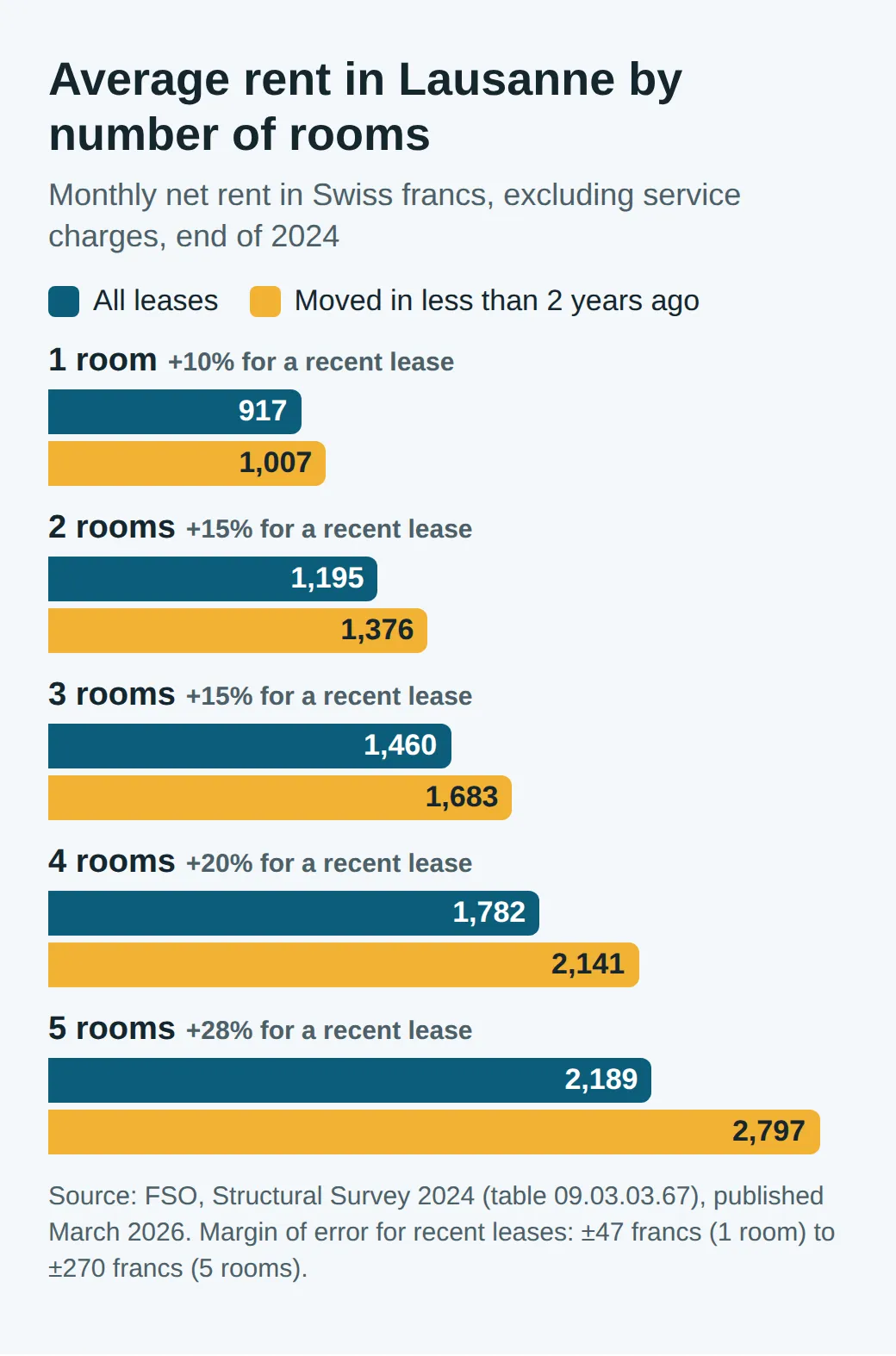
These figures come from the Structural Survey (the table is in French), which the FSO carries out every year among a sample of residents. Tenants report their net rent, meaning without service charges or heating, so charges come on top of every amount in this article. Because it's a sample, each average has a margin of error: CHF 23 for a 3-room apartment across all leases, but CHF 137 for a recently let 4-room apartment and CHF 270 for 5 rooms. For 6 rooms or more, the margin exceeds CHF 300 and the figure for recent leases (CHF 2,902) is even lower than the overall average (CHF 3,114). That's too few answers to draw anything from, so we leave them out.
The City of Lausanne has published the same series since 2010 in its housing tables (in French). They show the rise: the average rent for a 3-room apartment went from CHF 1,312 in 2018 to CHF 1,460 in 2024, up 11% in six years. Across all homes, the average went from CHF 1,259 to 1,398. We start in 2018 because the FSO changed its method that year, and older figures don't compare well.
Compared with the other big cities, Lausanne sits in the middle. Here is the same FSO table for a 3-room apartment at the end of 2024:
| City | All leases | Lease under 2 years old |
|---|---|---|
| Zurich | CHF 1,832 | CHF 2,125 |
| Geneva | CHF 1,527 | CHF 1,781 |
| Lausanne | CHF 1,460 | CHF 1,683 |
| Bern | CHF 1,479 | CHF 1,659 |
| Basel | CHF 1,447 | CHF 1,564 |
| Switzerland | CHF 1,446 | CHF 1,567 |
A recent lease in Lausanne costs about the same as across the canton as a whole: CHF 1,668 for 3 rooms according to Statistique Vaud (in French). If the CHF 1,460 average looks low next to it, that's because it also counts leases signed long ago. If you're aiming for Geneva rather than Lausanne, we cover finding a home in Geneva in a separate article.
Why a recent lease costs more than the average
Rent is set when the lease is signed, then changes little for as long as the tenant stays. A household that moved in twenty years ago keeps a price negotiated in another era, and it's households like that which pull the average down.
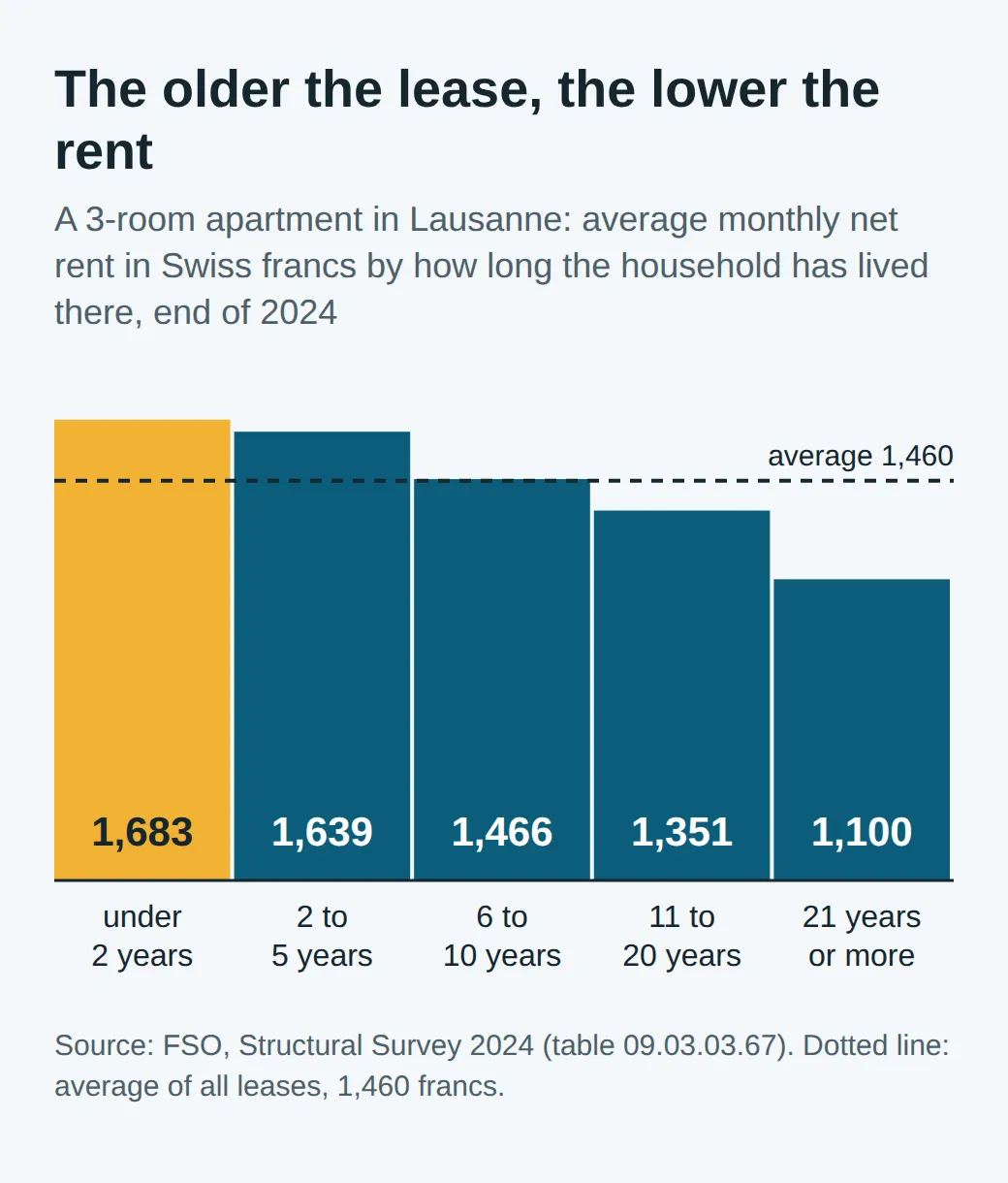
For a 3-room apartment, the gap is CHF 583 a month between a household that arrived less than two years ago (CHF 1,683) and one that has been there for 21 years or more (CHF 1,100). The second pays a third less for a home of the same size. The steps are almost even: each step in length of stay lowers the average rent. Length of stay doesn't explain everything, though. A new building only houses recent leases, so part of the gap comes from the age of the buildings as much as the age of the leases.
During a lease, the rent mainly follows the reference interest rate (in French) published by the Federal Office for Housing. It has stood at 1.25% since 2 September 2025, the Office left it unchanged in September 2026, and the next announcement is due on 1 December 2026. When a new tenant moves in, however, the landlord can set a new price, and that's the one you see in listings.
In practice, the average rent of CHF 1,460 often quoted for Lausanne rarely matches what you'll find when you search. Your benchmark is the recent-lease column. In the Vaud districts hit by the housing shortage, the landlord must also hand you an official form (formule officielle, page in French) when you sign the lease. For 2026, the Council of State's decree requires it everywhere except the district of Aigle, so in Lausanne too. The canton doesn't check the amounts on the form: if the initial rent looks unfair to you, a challenge goes to the prefecture of the district where the building stands, and that's a subject of its own.
That leaves the question everyone asks next: which neighbourhood?
Rents by neighbourhood: what the statistics still know
The City publishes no average rent by neighbourhood more recent than the one from the 2000 federal census. The reason is simple: the Structural Survey covers only a sample, and Statistique Vaud explains in its definitions (in French) that a sample can't give reliable results for small areas. The neighbourhood prices you'll find online, of the "a studio in Ouchy costs this much to that much" kind, don't come from public statistics and give neither their source nor their method.
What the City still publishes in its neighbourhood tables (in French) are the rents from the 2000 census, which back then counted every home. The amounts are long out of date: a 3-room apartment cost CHF 945 on average in the city then, against CHF 1,460 at the end of 2024. But they show where rents sat above or below the average. Mousquines/Bellevue was 24% above, the Centre 14%. At the other end, Montoie/Bourdonnette was 20% below and Borde/Bellevaux 15%.
The city has changed since, and not everywhere at the same pace. At the end of 2025, one Lausanne home in ten was in a building put up after 2010 (8,527 out of 82,539). These new buildings are concentrated in a few neighbourhoods, and in a new building every lease is recent. The table puts the two sources side by side:
| Neighbourhood | 3 rooms in 2000 | Gap from average in 2000 | Built since 2011 (end 2025) |
|---|---|---|---|
| Mousquines/Bellevue | CHF 1,170 | +24% | 4% |
| Centre | CHF 1,077 | +14% | 6% |
| Vallon/Béthusy | CHF 1,013 | +7% | 8% |
| Florimont/Chissiez | CHF 1,001 | +6% | 3% |
| Beaulieu/Grey/Boisy | CHF 999 | +6% | 5% |
| Sous-Gare/Ouchy | CHF 990 | +5% | 3% |
| Chailly/Rovéréaz | CHF 989 | +5% | 8% |
| Montchoisi | CHF 985 | +4% | 4% |
| Sauvabelin | CHF 968 | +2% | 38% |
| Sallaz/Vennes/Séchaud | CHF 960 | +2% | 22% |
| Maupas/Valency | CHF 941 | 0% | 3% |
| Montriond/Cour | CHF 939 | -1% | 6% |
| Sébeillon/Malley | CHF 931 | -1% | 17% |
| Vinet/Pontaise | CHF 907 | -4% | 2% |
| Bossons/Blécherette | CHF 907 | -4% | 29% |
| Borde/Bellevaux | CHF 805 | -15% | 8% |
| Montoie/Bourdonnette | CHF 757 | -20% | 15% |
Two things stand out. First, the southern and eastern neighbourhoods, from Sous-Gare/Ouchy to Mousquines/Bellevue, were already above average in 2000 and have built little since: you'll mostly find older buildings there, with leases of every age. Second, the north and west look quite different now. In Bossons/Blécherette, 29% of homes date from after 2010, largely because of the new Plaines-du-Loup district; in Sallaz/Vennes/Séchaud it's 22%, in Sébeillon/Malley 17%. Sauvabelin shows 38%, but out of only 416 homes.
In these neighbourhoods, new doesn't necessarily mean expensive. Statistique Vaud points out in a 2026 study of recently settled households (in French) that some of the new homes, as in Plaines-du-Loup, are public-benefit housing and remain within reach of low-income households. So treat the 2000 gaps as a pointer, not a price, and look at the age of the building as much as the address. For recent figures by place, you have to look beyond the city limits.
Lausanne or a neighbouring municipality?
Prilly, Renens, Ecublens and Crissier, to the west, are slightly cheaper than Lausanne; Chavannes and Bussigny slightly dearer; the municipalities to the east a good deal dearer. That's the finest geographic breakdown recent figures offer: Statistique Vaud publishes the average rent for every municipality with more than 5,000 inhabitants, pooling five years of surveys to get enough answers.
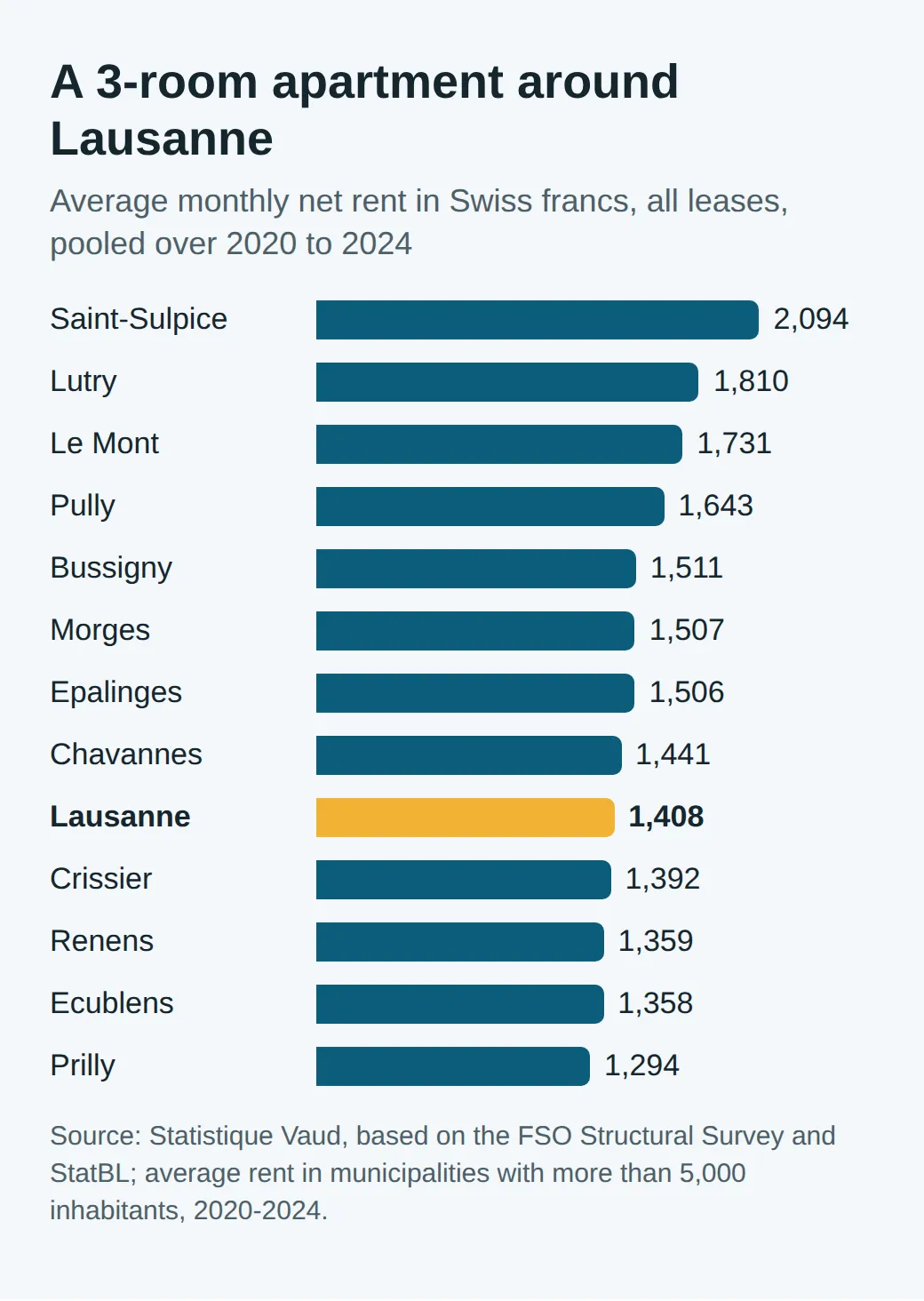
Over 2020 to 2024, a 3-room apartment cost CHF 1,408 on average in Lausanne, 1,294 in Prilly, 1,359 in Renens and 1,358 in Ecublens. To the east, Pully rises to CHF 1,643 and Lutry to 1,810. Above the city, Le Mont-sur-Lausanne reaches CHF 1,731 and Epalinges 1,506. Saint-Sulpice, on the lakeshore, is the most expensive on the list at CHF 2,094.
Two caveats apply to these averages. They cover five years and all leases, so they're lower than what a new tenant pays, just as in Lausanne itself. And small differences mean nothing: with a margin of error of CHF 37 in Crissier and CHF 10 in Lausanne, the CHF 16 between them falls within the uncertainty. Between Prilly and Pully, on the other hand, the CHF 349 gap is real.
For a 2-room apartment, the order is the same: CHF 1,158 in Lausanne, 1,080 in Prilly, 1,086 in Renens and 1,290 in Pully. Further out, Vevey (CHF 1,388 for 3 rooms) and Montreux (1,374) stay close to the Lausanne level, with Yverdon-les-Bains (1,243) below it. The full table is in Statistique Vaud's file on housing conditions (in French). Then you still have to find one that's available.
How many homes are vacant in Lausanne?
Very few: on 1 June 2026, the city had 523 vacant homes, or 0.63% of its housing stock, 497 of them for rent. In the statistics, a vacant home is one that is empty, fit to live in and offered to rent for at least three months or to buy. So it isn't the number of listings, but a snapshot taken on a given day.
The rate is creeping up, from 0.58% in 2025 to 0.63% in 2026, and stays below the cantonal average of 0.87%, according to provisional figures from Statistique Vaud (in French). The breakdown by size matters more than the rate. Of the city's 523 empty homes, 128 had 1 room, 144 had 2 and 148 had 3. There were only 67 homes with 4 rooms, 26 with 5 and 10 with 6 rooms or more. For a family looking for 4 rooms or more, that makes 103 empty homes in a city of more than 82,000. Relative to the stock of each size, about 1% of 1-room homes were empty, against 0.5% of 4-room homes.
That fits what we saw earlier: for large homes, a recent lease costs 20 to 28% more than the average, against 10% for 1 room. Where the choice is thinnest, the entry price moves furthest from the average. With these figures in mind, you'll read a listing differently.
How to judge a listing with these figures
Always compare net rent with net rent. If a listing shows an amount including service charges, take the charges off before comparing it with the averages in this article; if it doesn't break them down, ask. Then use the recent-lease column as your benchmark. A 3-room apartment at CHF 1,700 net is in line with a new Lausanne lease; at CHF 2,100 it's 25% above, and the listing should give a reason: a new building, a view, an unusually large floor area, the lake close by.
Keep rent-controlled housing in mind too. According to Statistique Vaud's definitions, the canton recognises four kinds, two of which concern most households. Subsidised homes (LLM, for logements à loyers modérés) have their rent lowered for 15 years and set every year by the canton, with occupancy conditions tied to income and household size. Affordable-rent homes (LLA, for logements à loyers abordables) are open to everyone, but the rental income they bring is capped. The averages above mix both in with other homes without telling them apart, and some municipalities apply their own allocation rules.
To test this against real offers, the city's listings are the best place to start. Open a few 3-room apartments, take off the charges and place them on the step chart above:
If you're looking on your own or setting up for the first time, studios are a market of their own, where a recent lease sits closest to the average (10% above it):
If Lausanne rents are beyond your budget, widen the search to the west, from Prilly to Ecublens, or to the whole canton of Vaud. And whichever home you take, be thorough with the move-in inspection: it's what protects you on the day you leave, as we explain in our article on the move-out inspection.
Common questions
Is rent cheaper in Lausanne than in Geneva?
Slightly. At the end of 2024, a 3-room apartment cost CHF 1,460 net on average in Lausanne and CHF 1,527 in Geneva, across all leases. For a lease under two years old, it was CHF 1,683 in Lausanne and CHF 1,781 in Geneva. Zurich is clearly higher, at CHF 2,125 for a recently let 3-room apartment.
Why do listings look more expensive than average rents?
For two reasons. A listing shows a home that is changing tenants, so it carries today's market price, while the average mixes in leases signed twenty years ago. And many listings show the rent including service charges, while the statistics count net rent.
How much does subsidised housing cost in Lausanne?
There is no single price. In a subsidised home (LLM), the municipality and the canton each lower the rent by 10% to 15% for 15 years, and the canton sets the rent every year based on costs. In return, occupancy conditions apply, on the share of income spent on rent and on the number of people per home. Ask the municipality before you start looking.
Will rents in Lausanne go down?
The figures published in 2026 don't point that way. The reference interest rate, which is used to adjust rents during a lease, has been 1.25% since 2 September 2025 and did not change in September 2026. And with 0.63% of homes vacant in the city on 1 June 2026, the market remains very tight, which does nothing to push rents on new leases down.
More from the blog
All posts
Lausanne housing cooperatives: how to join in 2026
Housing cooperatives in Lausanne or Geneva: who is eligible to join, what the cooperative shares cost and how the waiting lists work in 2026.
Student housing in Lausanne: FMEL rents and 2026 deadlines
FMEL, FSLE, flatshares and Geneva's Cité universitaire: Lausanne student rents house by house, the 6 to 9 month wait and the sign-up dates not to miss.
Move-out inspection in Switzerland: wear and tear or damage?
Normal wear and tear, item lifespans, the landlord's deadline, free conciliation: what you really pay at a move-out inspection in French-speaking Switzerland.