Move-out inspection in Switzerland: wear and tear or damage?
The short answer
You never pay for normal wear and tear. When you move out, you hand back a clean apartment, with the small repairs done, in the condition that comes from normal use. For real damage, you only pay the value the damaged item still had, based on its lifespan: as a rule, paint that is more than 8 years old costs you nothing.
A second rule matters just as much and is less well known: the landlord must report defects to you within days of the move-out inspection, or lose the right to charge you for them. The French depreciation grids you often find online do not apply in Switzerland. This guide relies on Swiss law, the joint lifespan table used in French-speaking Switzerland and a Geneva ruling from February 2026 that shows, invoice by invoice, what a court actually leaves for tenants to pay.
Normal wear and tear or damage: where is the line?
Normal wear and tear is what time and ordinary living leave behind in a home. The Swiss Code of Obligations says it in one sentence: at the end of the lease, you return the property "in a condition that accords with its contractually designated use". Paint that has faded over the years, marks left by picture frames, worn patches on the hallway parquet: that is wear and tear, and it is the landlord's cost, because your rent already pays for it.
Damage goes further: a cigarette burn in the carpet, a broken window, a cracked worktop, children's felt-pen drawings on the wall. ASLOCA Geneva, the tenants' association, uses picture frames as its example in an article from 2021 (in French): hanging pictures is normal use, so you fill the holes, but you don't have to repaint the walls, except in special cases.
The same article of the law holds a protection people often forget. Any clause signed before the lease ends that makes you pay for anything other than real damage is void. So a lease that sets a flat fee for painting or renovation when you leave does not bind you on that point: the landlord has to prove the damage and what it costs.
That leaves the awkward question: when the damage is real, how much is it worth? The answer is in a five-page table.
The joint table: how long each item lasts
In French-speaking Switzerland, the reference is the tableau paritaire des amortissements, a joint lifespan table. The Fédération romande immobilière, for landlords, and ASLOCA, for tenants, signed it in 2007, and the Union suisse des professionnels de l'immobilier (USPI) recognised it. It gives an average lifespan for every item in a home, from the boiler to the soap dish.
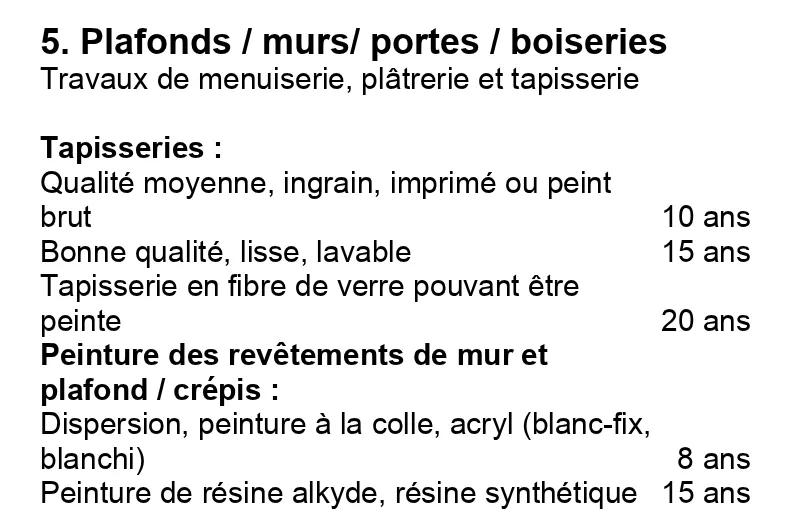
The table is not a law. Its own preamble says it has "no binding force" and gives indicative lifespans for equipment of ordinary quality. But the courts use it. In its ruling of 17 February 2026 (in French), the Geneva Court of Justice relied on it for the parquet, the kitchen and the bathroom.
The lifespans that come up most often when you move out:
| Item | Lifespan |
|---|---|
| Emulsion paint on walls and ceilings | 8 years |
| Medium-quality wallpaper | 10 years |
| Medium-quality fitted carpet | 10 years |
| Parquet sealing | 10 years |
| Solid parquet that can be sanded | 40 years |
| Medium-quality laminate | 15 years |
| Fridge with built-in freezer | 10 years |
| Dishwasher, cooker, oven | 15 years |
| Chipboard or MDF kitchen units | 15 years |
| Bathroom tile grout | 8 years |
One line deserves a closer look: parquet. Real wooden parquet lasts 30 to 40 years according to the table (12 years for veneered parquet that can't be sanded), but its sealing, the top coat that gets scratched, only lasts 10. If the invoice is for sanding and resealing, the 10-year lifespan is the one that counts, not the wood's.
How much you pay when the item is already old
You pay the current value of the damaged item, never the price of a new one. The Geneva Court of Justice, following the Federal Supreme Court, puts it this way: compensation does not match the cost of a new item; it takes account of the item's age and of the gain the landlord gets from a new one.
The table gives a lifespan, not a formula. The simplest calculation spreads the value in equal shares over each year of life, and that is the one used in the example in the Allianz Suisse fact sheet on damage to rented premises (in French): paint with an 8-year lifespan that is 6 years old on the day you leave is worth only 25% of its price. On a quote of CHF 1,000, for example, your share would be CHF 250. Paint that is 9 years old costs you nothing.
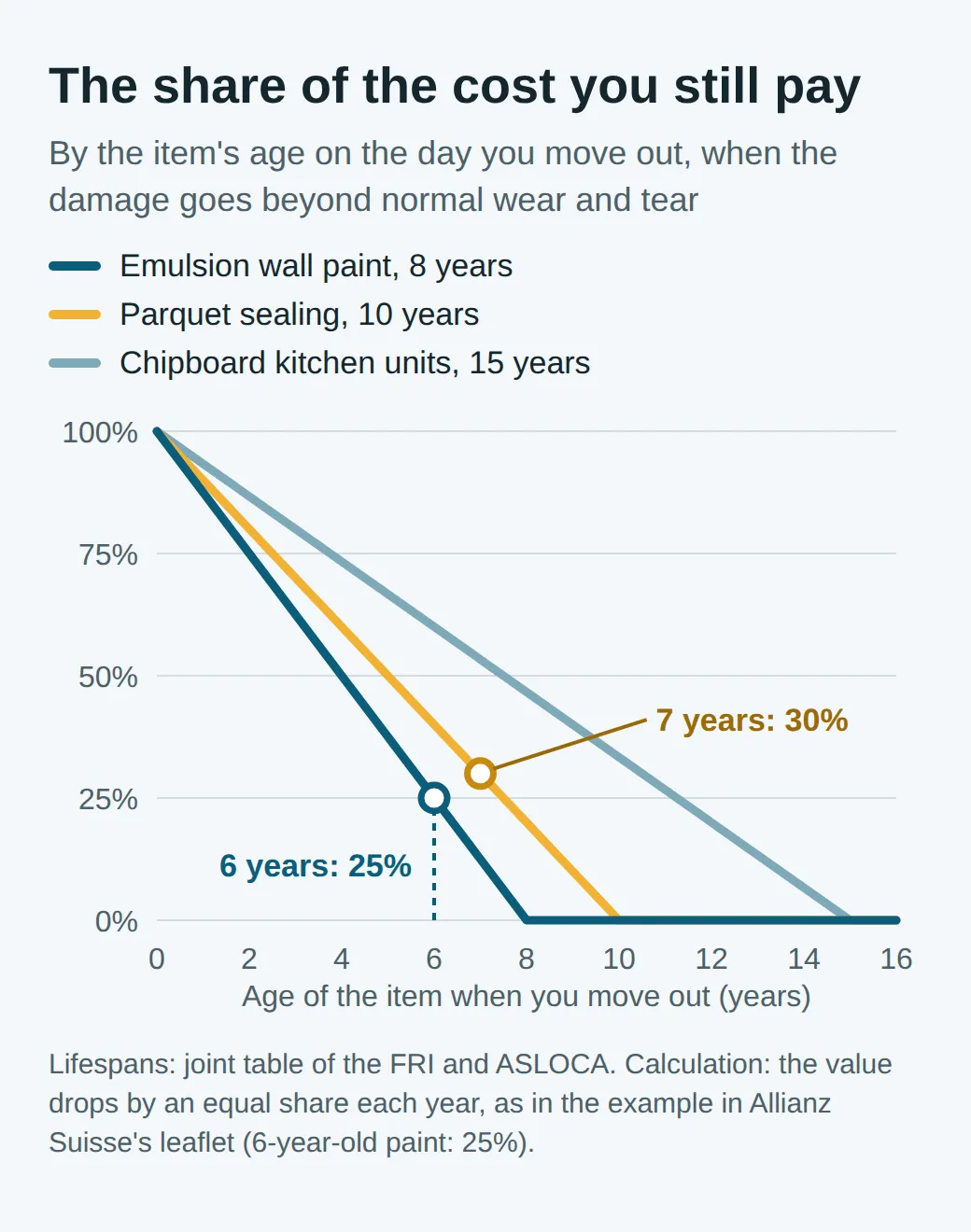
The age counts from the last renovation, not from the day you moved in. It is up to the landlord to prove when they repainted or fitted the item; without proof, the Geneva court went by the year the building was built. So ask for the invoice for the last paint job before you discuss the amount. And an item that is "fully written off" under the table is not always worthless: the landlord can prove that a quality material lasts longer, and you can prove the opposite. The judge keeps a lot of leeway, and the Geneva ruling is a good example.
A real case: CHF 18,131 claimed, CHF 7,016 upheld
The Court of Justice ruling of 17 February 2026 follows a move-out that went wrong from start to finish. Two tenants rented a furnished 5-room apartment in a building completed in 2015, for CHF 4,000 a month including service charges. The move-in report in October 2020 described the apartment and its furniture as "as new", apart from marks left by pictures on some walls. The lease ended at the end of December 2022.
The first move-out inspection, on 21 December 2022, recorded a lot of damage. The tenants also brought in a cleaning company and had some paintwork touched up. Noticing changes, the landlord held a second inspection on 7 January 2023, with some thirty points and photos. In the end she put her loss at CHF 18,131.
The court accepted a broken worktop, broken parts of the fridge and dishwasher, and bathroom fittings to replace, which the tenants admitted in principle. It also accepted the parquet, stained beyond normal wear according to the photos, even though the tenants disputed it. But it halved most of the repair invoices to account for the items' age, counting from the building's completion in 2015. With an equal drop each year, 7-year-old sealed parquet would have been worth only 30%; the court found 50% justified, partly because the move-in report described the parquet as "as new" and the lease had lasted only two years.
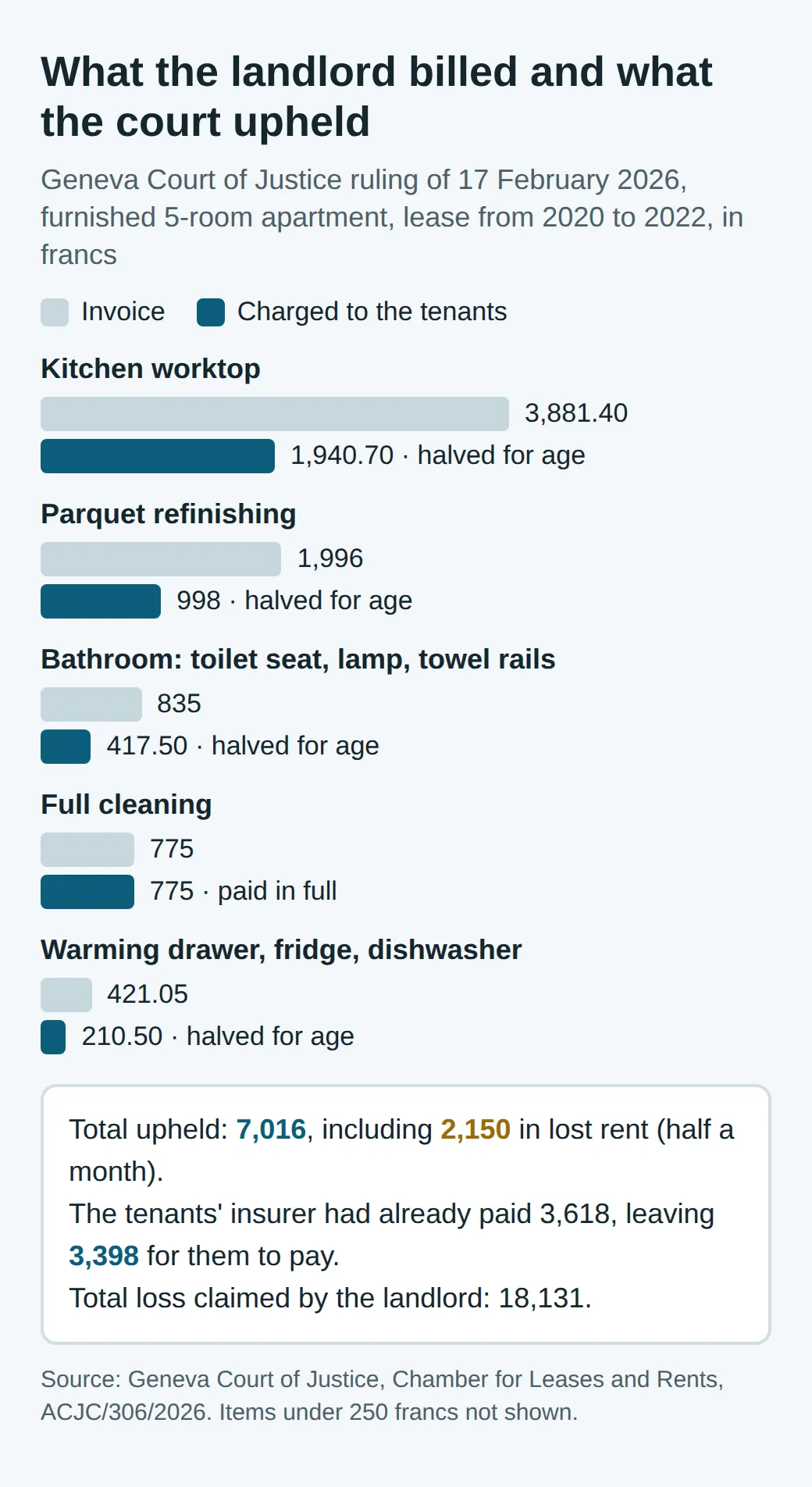
The cleaning, on the other hand, was counted in full: CHF 775, which makes sense, since cleaning has no lifespan to write off. The tenants had brought in their own company. The cleaner the landlord hired afterwards testified to grease on the living-room stove and dirt around the rug.
The biggest item wasn't a repair. The court added CHF 2,150 in lost rent, half a month, because the work, and two keys handed back only on 3 January, delayed reletting the apartment. Of the CHF 7,016 upheld in total, the tenants' insurer had already paid CHF 3,618; they still owed CHF 3,398. A stained parquet floor costs you less than an apartment that can't be relet. If you know that serious damage will need repairing, tell the agency (the régie) early, so it can schedule the work before the next tenant moves in.
Cleaning and minor repairs are still yours to pay
Cleaning and minor repairs are not wear and tear: you owe them in full. The law makes you responsible for defects that can be fixed by minor cleaning or repairs as part of regular maintenance, "depending on local custom". That local custom mostly means the cantonal rules.
In the canton of Vaud, the local rental rules (Règles et usages locatifs, in French), renewed and binding on every lease since 1 July 2026, are very concrete. A minor repair is one you can do yourself, without special skills or tools, for little money. Their examples include the shower head or hose, the washers of a simple tap, unblocking drains as far as the trap, light bulbs you can reach, oiling locks and hinges, and the cooker hood filter.
For cleaning, the Vaud rules ask you to hand the premises back clean and empty of your belongings, with every floor open for inspection. On top of the usual cleaning, you replace or clean the ventilation filter and clean the slatted blinds, the drains you can reach and the radiators. One more Vaud trap: if your own water heater has not been descaled in the last three years, descaling is done at your expense when you leave. In other cantons, read your lease and its general terms before you book a company.
Do you need a professional cleaning company? Neither the law nor the Vaud rules require one. What counts is the result on inspection day, and the Geneva case shows that a cleaner's invoice is not enough if the apartment is still dirty. If you hire one, keep the invoice and be there to check their work before the agency arrives.
Should you sign the move-out report?
Usually yes, as long as you know what you're signing. The report records a condition; it is not an admission that you owe money. The Vaud rules say so explicitly: the move-out report "is not an acknowledgement of debt". The Federal Supreme Court, cited by the Geneva court, takes the same line: a signed report that describes the apartment without saying which defects the tenant is blamed for does not count as notice of defects.
The danger lies elsewhere: a sentence such as "the tenant acknowledges owing the repair of…", or an amount written on the form. Then your signature carries weight. If you disagree, write your reservations next to each disputed point, or add a general statement next to your signature. Reports in French-speaking Switzerland are usually in French, so the wording ASLOCA Geneva suggests is best written as it stands:
Ma signature ne vaut pas reconnaissance d'une quelconque responsabilité quant aux défauts que le bailleur entend mettre à ma charge.
(My signature does not acknowledge any liability for the defects the landlord intends to charge to me.)
Come in person, with your move-in report and your lease. Photograph every point you discuss, close up and from a distance. Don't sign a payment order or a release of your rent deposit on the spot for an amount you dispute. If you don't feel comfortable, bring someone along: in the Lausanne, Morges, Renens and northern Vaud region, ASLOCA charges its members CHF 80 an hour excluding VAT for this help, subject to availability.
Notice of defects: days, not weeks
The landlord must inspect the apartment when you hand it back and inform you immediately of any defects they hold you responsible for. If they don't, you are off the hook, except for defects a normal inspection could not have revealed.
"Immediately" has a precise meaning. The Federal Supreme Court, followed by the Court of Justice in the 2026 ruling, generally allows two or three working days after the inspection, sometimes a week. Notice given three weeks or a month after the handover is as a rule too late. The clock starts on the day the landlord discovers the defects, not when the keys come back: in the Geneva case, the second inspection on 7 January 2023, sent on 9 January, was in time, even though the last keys had arrived on 3 January.
The notice also has to be specific. "Stains in the kitchen" is not enough: it needs a list that lets you identify each item of damage you are blamed for. And it is up to the landlord to prove that the notice went out in time, that the damage goes beyond normal wear and what it costs. In practice, note the date of the inspection and keep the envelope or email that follows. A claim letter that arrives a month later, listing defects that were visible on the day and missing from the report, gives you a strong argument.
Your rent deposit, locked at the bank
Your deposit is not a cash box for the landlord. The Code of Obligations caps it at three months' rent and has it held in a bank account in your name. The bank only releases it with the consent of both parties, on a payment order you did not object to, or on a final court decision.
If the landlord has brought neither a lawsuit nor debt collection proceedings within a year of the lease ending, you can ask the bank to return the deposit to you, without their consent. If they send you a payment order (commandement de payer) for an amount you dispute, object, verbally or in writing: straight away to the person who serves it, or within ten days at the debt collection office. And only sign a partial release for the sum you really agree to pay; the rest can stay locked while you talk it over.
If the talks go nowhere, the next step costs nothing.
If you can't agree: the conciliation authority
Before any court, a rental dispute goes to a joint conciliation authority, with a chair, a tenants' representative and a landlords' representative. In rental cases the procedure is free of court costs. These authorities also have the job of giving the parties legal advice. You file a written application, or dictate it on the spot, with the landlord's name, what you are asking for and a description of the dispute, plus the documents: lease, inspection reports, photos, invoices, letters.
The hearing takes place within two months. You attend in person, with someone alongside you if you like; the landlord can be represented by the agency's property manager. If no agreement is reached, there are three possible outcomes. The authority can propose a decision in a money dispute up to CHF 10,000, which becomes final if nobody objects within 20 days. At the request of the party that brought the case, it can decide the matter itself up to CHF 2,000. Otherwise, it issues an authorisation to proceed, and you then have 30 days to take the case to court. The CHF 10,000 threshold has applied since 1 January 2025; the Geneva and Vaud pages still say CHF 5,000, but the federal law is what counts.
The authorities in French-speaking Switzerland, according to the list from the Federal Office for Housing:
| Canton | Authority | Where |
|---|---|---|
| Geneva | Commission de conciliation en matière de baux et loyers | Rue de l'Athénée 6-8, Geneva |
| Vaud | Commission préfectorale de conciliation | The prefecture of the district where the home is |
| Neuchâtel | Chambre de conciliation of the regional court | La Chaux-de-Fonds, Neuchâtel or Boudry |
| Fribourg | Commission de conciliation en matière de bail | Fribourg, Tafers (Tavel) or Romont, depending on the district |
| Valais | Commission cantonale de conciliation en matière de bail à loyer | Avenue du Midi 7, Sion |
| Jura | Commission de conciliation en matière de bail à loyer | Delémont, Le Noirmont or Porrentruy, depending on the district |
| Bernese Jura | Autorité régionale de conciliation Jura bernois-Seeland | Rue de l'Union 13, Biel/Bienne |
In the Geneva case, the landlord went to the commission in March 2023, the hearing in June ended without agreement, and the case then went through two courts until February 2026. A reasonable settlement before the commission would have saved both sides nearly three years.
Before you hand back the keys
The work starts a few weeks before moving-out day. Reread your move-in report: any defect listed there is not yours. For each item of damage you know is real, find its line in the joint table and ask the agency when it was last renovated. Do the minor repairs yourself and fill the holes, but don't repaint walls whose paint is more than 8 years old, and don't order major work from a tradesperson without the agency's agreement: the Allianz fact sheet points out that whoever places the order pays the bill. Report any accidental damage to your insurer before the inspection. Then turn up on the day with your photos, your documents and, if needed, someone to support you.
If you are already looking for your next home, make the move-in report your first priority: ask for the previous tenant's move-out report, note every scratch and stain, and keep the photos until the day you move out in turn. You'll find listings in the region in the canton of Vaud, for example, or in Geneva and Lausanne:
Common questions
Can a landlord charge for damage found after the move-out inspection?
Only if the damage could not have been spotted in a normal inspection, such as hidden water damage. In that case the landlord must tell you as soon as they find it. A defect that was visible on moving-out day, and that the landlord did not report in time, can no longer be held against you.
Who pays for a lost key when you move out?
You must hand back every key, including copies you had made yourself. In the canton of Vaud, the local rental rules say you replace a lost key, but you only pay for a new cylinder in the front door if it is a security lock. Elsewhere, check your lease and its general terms.
Does personal liability insurance cover damage to a rented apartment?
Often, for sudden and accidental damage, such as a tile cracked by something you dropped. Allianz Suisse, for example, says it does not cover damage that builds up over time, like walls yellowed by smoke, or putting back your own changes, like a wall you painted green. Report the claim early and read your policy, because every contract is different.
Can you ask to see the previous tenant's move-out report?
Yes. If a report was drawn up when the previous lease ended, the landlord must show it to you on request when you take over the apartment. Ask for it when you move in: it proves which defects were there before you, so you are not held responsible for them when you leave.
More from the blog
All posts
Lausanne housing cooperatives: how to join in 2026
Housing cooperatives in Lausanne or Geneva: who is eligible to join, what the cooperative shares cost and how the waiting lists work in 2026.

Average rent in Lausanne: 2024 figures by number of rooms
Average rent in Lausanne by number of rooms, for new and older leases, by neighbourhood and in nearby towns, from FSO and Statistique Vaud figures.

Finding an apartment in Geneva in 2026: a realistic guide
Only 0.31% of homes are vacant. How to find an apartment in Geneva in 2026: letting agencies, your application, HBM and HLM, City housing, scams and timing.