How to challenge your initial rent in Geneva and Vaud (2026)

Before day 30
You have 30 days from the day you get the keys to challenge your initial rent before the conciliation authority. It costs nothing, you keep your lease, and a notice to quit served during the proceedings can be annulled. In Geneva and almost everywhere in the canton of Vaud, the official form tells you what the previous tenant paid: that's your starting point.
People do use this right. In the second half of 2025, the conciliation authorities closed 138 initial rent challenges in Geneva and 207 in the canton of Vaud. This guide follows the order in which things happen: reading the form, counting the 30 days, weighing your chances, writing the application, attending the hearing. It draws on the law, the cantonal forms, federal statistics and five Federal Supreme Court rulings. Where an English version exists, we link it; most of the other texts are in French, and two of the rulings are in German.
Who can challenge their initial rent?
You can challenge it if the rent is unfair and one of two conditions is met. The Code of Obligations sets them out: either you had to sign the lease out of personal or family necessity, or because of the state of the local housing market; or the landlord raised the rent significantly compared with what the previous tenant paid.
The first condition is almost always met around Lake Geneva. In 2016 the Federal Supreme Court ruled that a housing shortage is enough: the tenant doesn't also have to prove personal hardship. The case concerned a 3.5-room apartment in Zurich let for 3,900 francs a month plus charges, in a city where 0.11% of homes stood empty. Official statistics are sufficient proof. In Geneva, the cantonal government finds a shortage in every category for 2026, from 1 room to 7 rooms and more. In the canton of Vaud, Statistique Vaud counts 0.87% of homes vacant on 1 June 2026, on provisional figures.
That leaves showing that the rent is unfair. A rent is unfair when it gives the landlord an excessive return on the building. How that's worked out depends on the building's age. For a building built or bought less than 30 years ago, the question is what the landlord earns on the money invested. Since a 2020 ruling, the permitted return is the reference interest rate plus 2 percentage points, as long as that rate doesn't exceed 2%. With a reference interest rate of 1.25%, unchanged since September 2025, that makes 3.25% by our calculation. For an older building, it's mainly the usual rents in the neighbourhood that count.
You can't do this calculation on your own: you need the landlord's figures. But the official form already gives you a first point of comparison: your predecessor's rent.
The official form: what it must tell you
In Geneva and the canton of Vaud, the landlord must give you an official form with every new lease for as long as the shortage lasts. Federal law leaves this choice to the cantons, and both have made it. Geneva's law (Art. 207) requires the form to reach you at the latest on the day you take over the home. Vaud's law requires it when the contract is concluded. For 2026, a decree of the Vaud cantonal government exempts only the district of Aigle.
Its contents are set by law. You should find the previous tenant's net rent and charges (in Vaud, with the date from which they paid them), your new rent, the precise reason for any increase, your right to challenge, the deadline and the address of the conciliation authority. Since 1 October 2025, the federal ordinance has required two more lines: the reference interest rate and the consumer price index on which the old rent was based. The Vaud form now includes them.
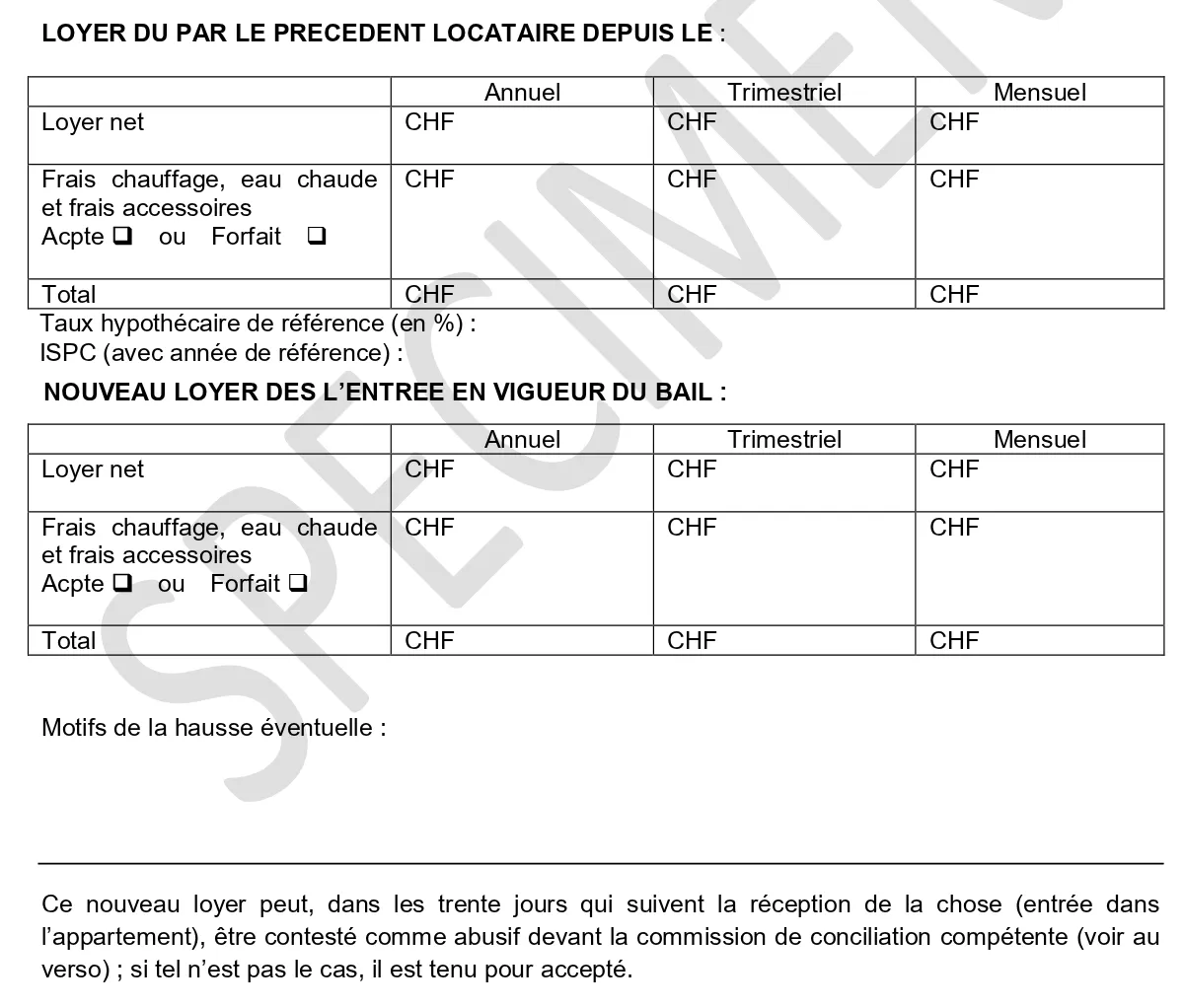
These two lines let you check whether the increase is explained by changes in interest rates and prices, a point the Federal Supreme Court looks at. If the old rent was already based on a rate of 1.25% or more, interest rates explain no increase at all: the reference rate has stood at 1.25% since September 2025. An increase justified only by "adjustment to local rents" or "works", with no amount, is a warning sign too: the law asks for a precise reason.
The canton of Vaud is clear on this: the canton approves only the form, not the amounts written on it. A form in order says nothing about whether the rent is fair, and that is exactly what the conciliation authority can examine.
The 30-day deadline runs from the keys
The deadline starts on the day you take possession of the home, which in practice means the day you get the keys. Not the date you signed the lease, and not the date of your first rent payment. If you sign in August and get the keys on 1 October, your 30 days start on 1 October. Once they've passed, the Vaud form puts it plainly: the rent is "deemed accepted" (« est tenu pour accepté »).
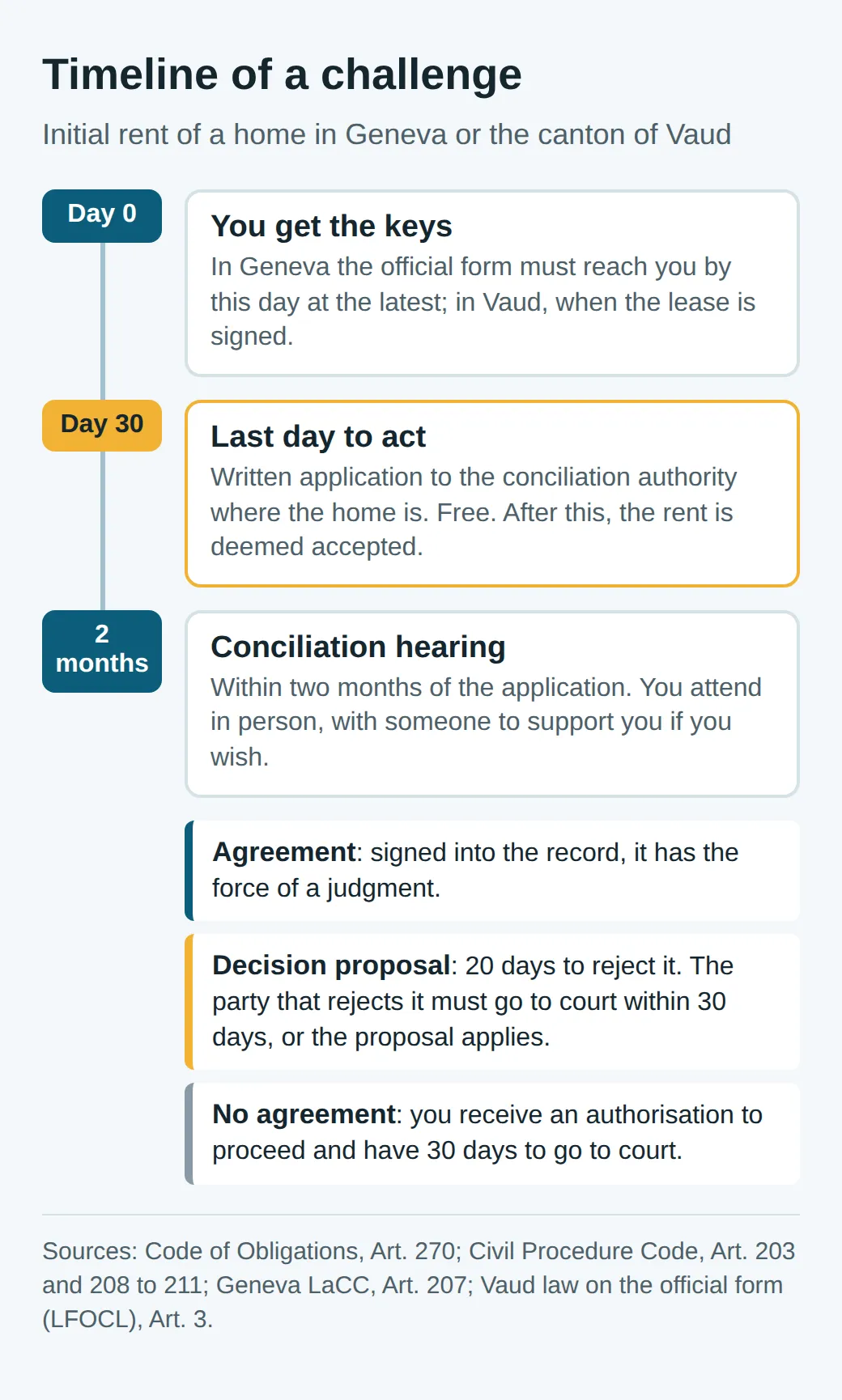
Don't wait for the last day. In Geneva you can hand in your application at the counter; elsewhere, sending it by registered post a few days before the deadline gives you proof. One situation calls for advice: if the form reaches you after the keys, it arrives later than the Geneva and Vaud laws require, and neither law says what happens then. Count your 30 days from the keys and get advice from the tenants' association ASLOCA straight away: that's the safest reading.
What if the form never reached you at all? The 30-day deadline no longer locks you in, but time still matters.
No form? Then the rent was never validly set
Without the official form, where it's mandatory, the clause in the lease that sets the rent is void. The court then sets the rent itself, and you can claim back what you overpaid. The leading case comes from Nyon. A couple rented a 3.5-room apartment from November 2009 for 1,810 francs net a month, without a form. The previous tenant had paid 1,770 francs. In July 2012 the tenants went to ASLOCA, and a week later they applied to the conciliation authority.
Vaud's tenancy court, the Tribunal des baux, set the rent at 1,500 francs from the start of the lease, then 1,380.75 francs from November 2012. The landlords had to repay 17,169.50 francs. The Federal Supreme Court upheld this in 2015: with no documents from the landlord to calculate the return, the court could rely on statistics. It also refused to set the rent at the previous tenant's level, as the landlords had asked.
There are two limits. The claim for repayment lapses after three years from the day you learn you're entitled to it, and after ten years at most. And waiting can backfire. In a case decided in 2001, the tenants of a villa had paid their rent without reservation for almost seven years, then stopped paying. They raised the missing form only before the court that was to decide on their eviction: the Federal Supreme Court saw this as an abuse of rights, and the eviction was upheld. As soon as you find out the form is missing, act.
Your chances: what the numbers say
Most challenges are settled before the conciliation authority, without a court case. For the second half of 2025, the Federal Office for Housing's statistics count 670 initial rent cases closed across Switzerland. Geneva, Vaud and Zurich account for 85% of them. In Geneva, 109 of the 138 cases ended in conciliation, meaning a settlement, a claim accepted or a claim withdrawn. In the canton of Vaud it was 103 of 207, plus 46 where both parties accepted the authority's proposal.
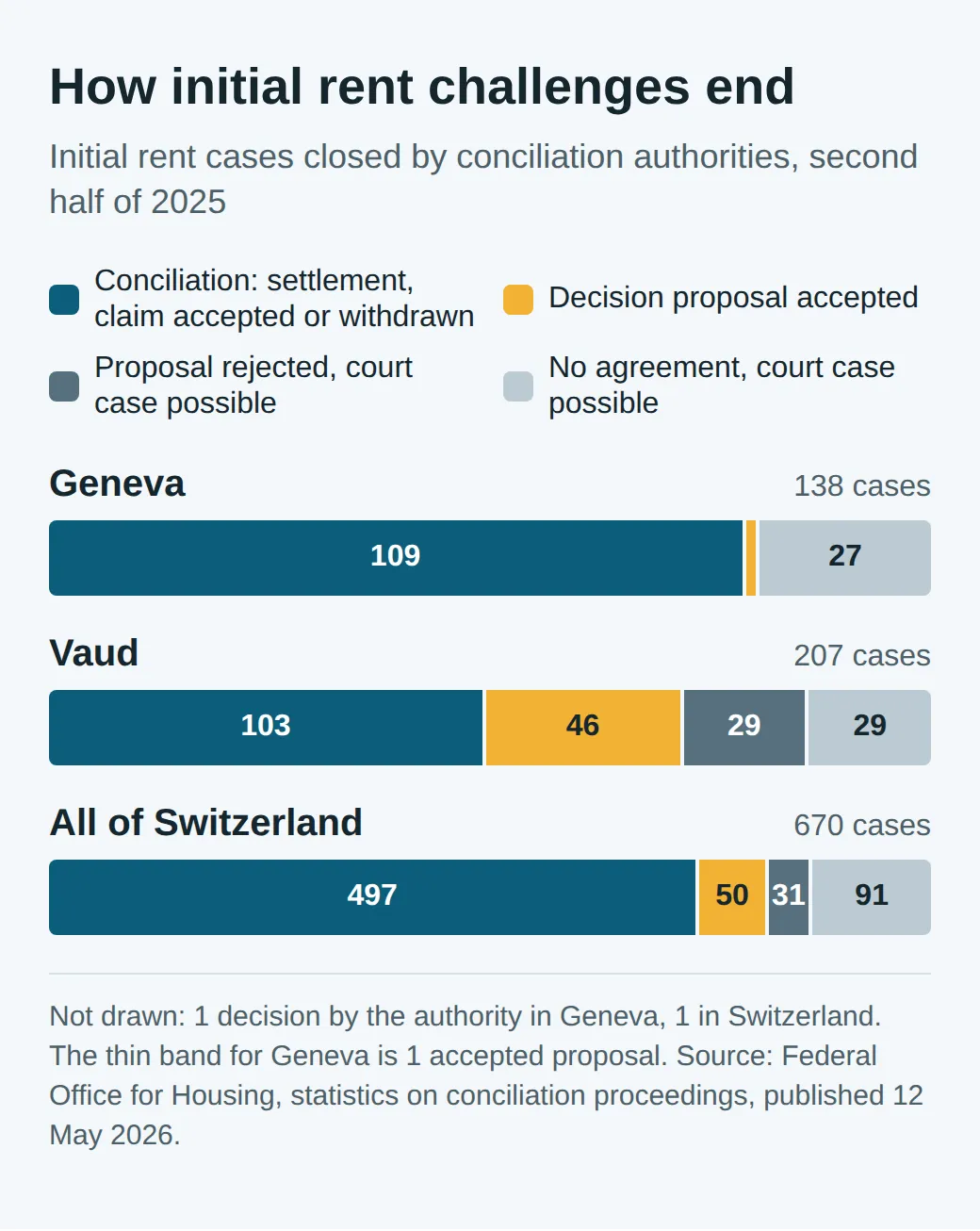
Read these numbers with care. The statistics don't say who got what: a closed case can be a negotiated reduction, a landlord accepting the claim or a tenant withdrawing theirs. They also show how many cases go further: in Geneva, about one in five ends with an authorisation to go to court, and in the canton of Vaud slightly more than one in four.
Your chances depend on how far your rent is above the old one. In 2021 the Federal Supreme Court ruled that a massive increase creates a presumption that the rent is unfair. The case concerned a 2-room apartment in Zurich that went from 738 to 1,060 francs net, roughly 44% more; the tenancy court had set the rent at 855 francs. An increase of more than 10% isn't enough on its own. And the landlord can overturn the presumption with evidence that raises serious doubt: three or four comparable homes backed by a statistic, for example, or a previous lease that had lasted 15 to 20 years. The Federal Supreme Court in fact sent the case back to the cantonal court to examine the landlord's evidence.
So prepare your own evidence, because once doubt sets in, it's up to you to prove the rent is unfair, with five comparable homes or an official statistic. Note the rents of similar homes in the neighbourhood, with floor area, the building's age and fittings, from landlords other than yours. Compare your rent with official statistics: for Lausanne, our article on rents by number of rooms gives the averages for recent leases. And check the building's age: if it was built or bought less than 30 years ago, the landlord will in principle have to show the figures for its return.
The application and the conciliation hearing
The application is a simple letter, and it's free. The Civil Procedure Code asks for three things: the name of the other party, what you're asking for and a description of the dispute. No court costs are charged in tenancy disputes at this stage.
In Geneva, you write it in French and send it to the Commission de conciliation en matière de baux et loyers, by post or at the counter at Rue de l'Athénée 6-8. The commission offers a form for challenging the initial rent, in French, but a signed letter is enough. In the canton of Vaud, the application goes to the prefecture of the district where the home is, with the relevant documents. For the other French-speaking cantons, our article on the move-out inspection lists the authorities. Both cantons work in French, so here is a sample letter in French you can adapt:
Requête de conciliation : contestation du loyer initial. Bailleur : [nom et adresse de la régie ou du propriétaire]. Logement : [adresse, étage, nombre de pièces], reçu le [date]. Je conteste le loyer initial de [montant] francs nets par mois. Selon la formule officielle, le locataire précédent payait [montant] francs. Je demande que le loyer soit fixé à un montant non abusif dès le début du bail, et que le bailleur produise les pièces permettant de calculer le rendement de l'immeuble. Annexes : bail, formule officielle.
In English, the letter names the landlord or agency and the home, gives the date you got the keys, states the net rent you're challenging and what the previous tenant paid according to the form, and asks for a fair rent from the start of the lease, with the landlord ordered to produce the documents needed to calculate the building's return. The lease and the official form go with it.
The hearing takes place within two months. You attend in person, with a legal adviser or someone you trust if you like; the landlord can send the property manager from the agency. What you say there isn't recorded in the minutes and can't be used later in court, so you can negotiate freely.
There are three possible outcomes. An agreement, signed into the record, has the force of a judgment. The authority can also make a proposed judgment, with no limit on the amount where the rent is unfair. If no one rejects it within 20 days, it applies. If the landlord rejects it, it's up to the landlord to go to court within 30 days; otherwise the proposal stands as a decision. The same rule applies to you if you're the one who rejects it. The canton of Vaud uses this tool a lot, as the chart shows. Finally, if there's no agreement, you receive an authorisation to proceed and have 30 days to go to court. In Geneva, cantonal law charges no fees in tenancy cases, even in court.
Challenging without losing your home
Challenging your rent right after landing an apartment can feel risky. The law protects you in two ways. First, the lease stays in force unchanged during the proceedings: you pay the rent in the contract and you stay in your home.
Second, notice given by the landlord can be annulled if it falls during conciliation or court proceedings. The protection lasts another three years after the proceedings end if the landlord largely lost, reduced their claims or reached an agreement with you. There are exceptions, for example if you don't pay your rent or if the landlord urgently needs the home for themselves or their family. A notice given during those three years can also be challenged, within 30 days.
One last practical point: challenging doesn't stop you moving in. You sign the lease, move in, then challenge within 30 days. You don't have to choose between the apartment and your rights.
Before you sign your next lease
If you're still looking, ask to see the official form before you sign, or at least the previous tenant's rent. Note what the listing said about the apartment and keep a screenshot of it: you'll want it for comparison later. Our guide to finding an apartment in Geneva explains how to prepare your application file and where to look.
On the day you get the keys, put the date in your calendar with a reminder on day 20. That leaves you time to read the form, ask ASLOCA for advice and send your letter without rushing. Current listings, to get a feel for the rents being asked:
Common questions
Do all co-tenants have to sign the rent challenge?
The article of the law on the initial rent doesn't say. The tenants' association of the canton of Bern advises that everyone who signed the lease should sign the letter, along with a spouse or registered partner. That is the safest route, and it only costs one more signature.
Do I have to keep paying the full rent while I challenge it?
Yes. The lease stays in force unchanged during conciliation and any court case, so you pay the rent set in the contract. The agreement or the judgment then says from when the new rent applies: in the Nyon case, the court set it from the start of the lease and ordered the landlords to repay what had been overpaid.
Is a rent 10% higher than the previous tenant's automatically unfair?
Not on its own. In 2021 the Federal Supreme Court ruled that an increase of more than 10% isn't enough by itself to presume the rent is unfair: it takes a massive increase, like the 44% in the case it decided, that the reference interest rate and inflation don't explain. You can still challenge a smaller increase, but you'll need more evidence.
Can I challenge my initial rent outside Geneva and Vaud?
Yes, the 30-day rule applies throughout Switzerland. What varies is whether the official form is mandatory, which each canton decides. The canton of Bern, for example, has required it since 1 December 2025. Without a form, ask the landlord or the previous tenant how much the home cost before you.
More from the blog
All posts
Apartment too cold in Switzerland? Minimum temperature rules
No legal minimum in Switzerland: the 18 °C and 20 to 21 °C court thresholds, proving the cold, writing to the landlord, rent reduction, rent on deposit.

Fixed-term lease in Switzerland: your rights and pitfalls
Fixed-term lease in Switzerland: how it ends without notice, tacit renewal, the 60-day extension deadline, leases the Federal Supreme Court made open-ended.

Lausanne housing cooperatives: how to join in 2026
Housing cooperatives in Lausanne or Geneva: who is eligible to join, what the cooperative shares cost and how the waiting lists work in 2026.