Rent deposit insurance or deposit account: the real cost

The numbers in brief
A blocked rent deposit account costs you next to nothing: between 0 and 100 francs in one-off fees at BCV or BCGE, and interest close to zero. Rent deposit insurance costs 4.2 to 5.7% of the deposit every year, and you never get it back: 1,060 to 1,430 francs over five years for a 3-room flat in Lausanne. And if the landlord claims money, the insurer pays, then claims it back from you.
So the insurance doesn't replace the deposit. It saves you from tying up the money, in exchange for a premium. That helps if you don't have the cash on the day you sign, or if your old deposit is still blocked. In every other case, the numbers point clearly to the account. We read the laws of Geneva and Vaud, the fee schedules of two cantonal banks and the general terms of three insurers, AXA, SwissCaution and Firstcaution, which we quote without ranking them.
What the law requires when you sign
The landlord can ask for a deposit, but the Code of Obligations sets limits. For a home, it can't exceed three months' rent. If you pay it in cash, the landlord must put it in a bank, in an account in the tenant's name. Cantons can add their own rules, and both Geneva and Vaud have.
In the canton of Vaud, the Règles et usages locatifs, the cantonal rental rules (PDF in French), which apply to all leases since 1 July 2026, add two points. The deposit can't exceed three months' net rent, so without service charges. And you must prove it has been set up within 30 days of signing, and no later than the day you move in. The same rules allow both routes: a deposit with a bank or with an organisme de cautionnement, a surety provider.
The Vaud law on rent deposits (in French) adds a safeguard. For a home, only a simple surety is allowed, and only "at the express request of the tenant". So nobody can force insurance on you instead of an account. And you can replace the surety with a cash deposit of the same amount at any time.
In Geneva, the law protecting deposits provided by tenants (in French) says the same thing, almost word for word.
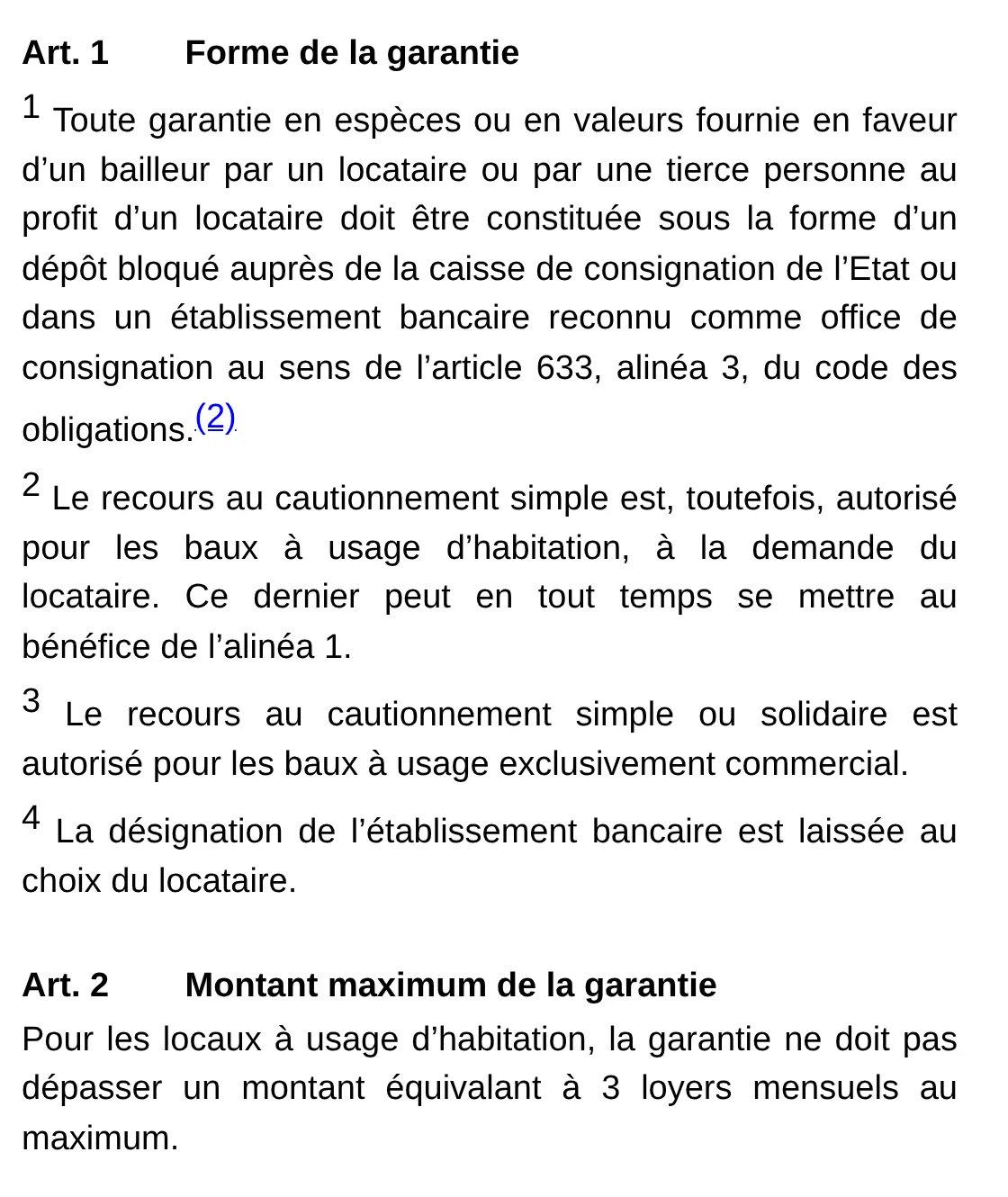
The same law requires the bank to pay at least the usual savings rate of the Banque Cantonale de Genève on the account. One question the texts leave open: does the landlord have to accept insurance? AXA says the landlord can refuse it and insist on a bank deposit. ASLOCA Geneva, the tenants' association, notes in an article from 2019 (in French) that letting agencies generally accept it, but that you should get this confirmed first. Ask in writing, before you pay the first premium.
What a deposit account really costs
Almost nothing in fees, and it earns almost nothing either. At Banque Cantonale Vaudoise (BCV), the rate on the rent deposit account (in French) has been 0.00% since 1 May 2026. The bank charges 100 francs per account, once, if you aren't already a customer, and its fee schedule (in French) waives it if you have an active private account there, with your salary paid into it for example.
At Banque Cantonale de Genève (BCGE), managing the account is free, and its rate table as of 1 October 2026 gives 0.01% for the rent deposit, exactly the rate of its savings account. On a deposit of 5,049 francs, that's 50 centimes a year. The interest is yours: the Vaud law states that you can withdraw it with your signature alone.
So the real cost of a deposit account doesn't show up on any bill. It's what that money could have earned elsewhere, or the debt you could have avoided with it. Next to a savings account, the gap is tiny: the BCV savings rate is 0.025%. It only becomes real if you have a better use for the money, or if you simply don't have it.
What rent deposit insurance costs
All three insurers publish their rates, and the premium is based on the amount of the deposit, not on the rent. On top of it comes the federal stamp duty, 5% of the premium, which applies to all insurance of this kind. The differences lie in the fees and in what happens on the day the landlord makes a claim.
| Insurer | Annual premium | Other published fees | If the landlord claims |
|---|---|---|---|
| AXA | 4% of the deposit, plus stamp duty | No entry fee; 10% off with its personal liability insurance | Repay at once, interest and costs included |
| SwissCaution | 5% of the deposit, plus CHF 20 and stamp duty | Flat sign-up premium, amount not published | Repay without delay, plus a CHF 100 fee |
| Firstcaution | 5% from year 2, plus CHF 20 and stamp duty | Flat first year: CHF 120 in its example (deposit of CHF 3,900, moving in July) | Repay within 30 days; CHF 200 if debt collection starts |
The sources for this table are AXA's offer page and its general insurance conditions, SwissCaution's general terms and, for Firstcaution, its pricing page and its general terms. All of them offer discounts. SwissCaution advertises 10% off for under-26s and a 10% loyalty discount from the second completed year. Firstcaution promises to pay back 20% of the premiums at the end of the contract if the landlord made no claim, you always paid on time and the contract lasted at least 12 months. AXA caps its cover at 20,000 francs.
As a percentage, the 4% rate comes to 4.2% with stamp duty. The 5% rate plus 20 francs comes to 5.7% for a deposit of around 5,000 francs, because the 20 francs weigh more on a small amount. What's left is turning those percentages into francs.
The cost over 1, 3 and 5 years in Lausanne and Geneva
For a 3-room flat in Lausanne, the insurance costs you between 1,060 and 1,430 francs over five years. For a 4-room flat in Geneva, between 1,397 and 1,852 francs. We started from the average net rents of households that moved in less than two years ago, published by the Federal Statistical Office (FSO) in its table by major city: 1,683 francs for a 3-room flat in Lausanne and 2,218 francs for a 4-room flat in Geneva, in 2024. Three months' net rent gives deposits of 5,049 and 6,654 francs. Our posts on rents in Lausanne and on flat hunting in Geneva say more about these two markets.
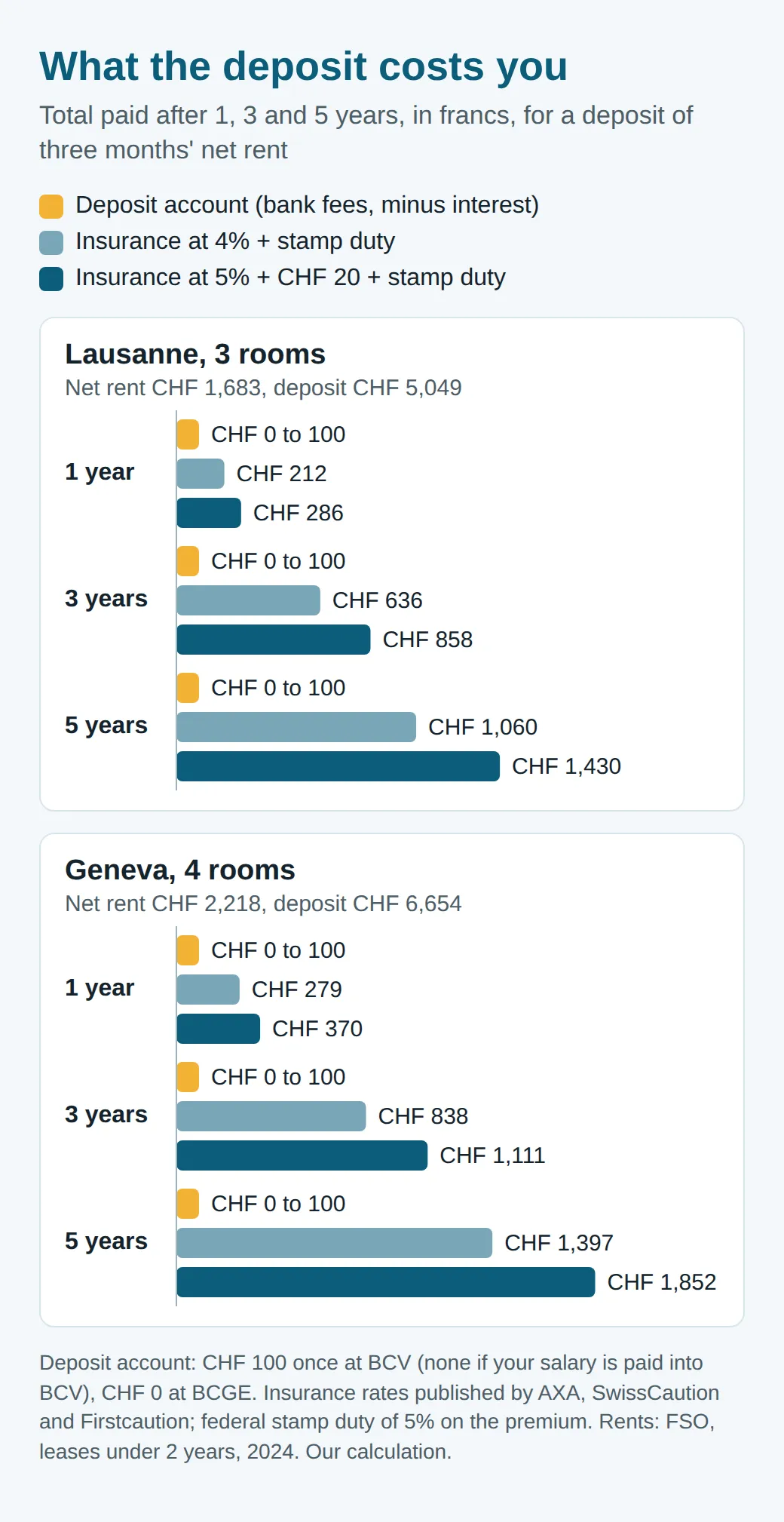
The chart simplifies one point: at Firstcaution, the first year is a flat amount that depends on the month you move in, not the annual rate. With its example of 120 francs for a July start, the first year costs less than the chart shows. Firstcaution's 20% payback, if it applies, brings the five Lausanne years down from 1,430 to about 1,150 francs. SwissCaution also charges a flat sign-up premium, but its terms don't give the amount. None of this changes the order of magnitude.
Another way to read these figures helps you decide. Paying 4.2 to 5.7% a year so as not to tie up your own money is like borrowing it at that rate. ASLOCA Geneva even suggests comparing with a bank loan, whose rate can be close to the premiums, and putting the borrowed money into a deposit account. If your money is sitting in a savings account, the insurance is a bad deal. If you don't have it, or you need it for the move, it can be worth the price. And these premiums are never refunded: they aren't deducted from what you owe if the landlord makes a claim either.
When the landlord claims, you pay
Rent deposit insurance isn't insurance against damage. AXA says so in black and white: the landlord's claims are not covered "but only advanced", and you must repay everything the insurer has spent. That clause changes how you should see the premium: you aren't paying to be covered, you're paying not to tie up the money.
What triggers a payout follows the same rules as at the bank. All three insurers only pay the landlord on one of the documents the law requires for a deposit account: your written consent, a payment order you didn't object to, or an enforceable court judgment. AXA keeps an exception for when these documents can no longer be obtained, for example when the tenant has left without a forwarding address. Once it has paid, the insurer takes the landlord's place, as the Code of Obligations provides, and turns to you.
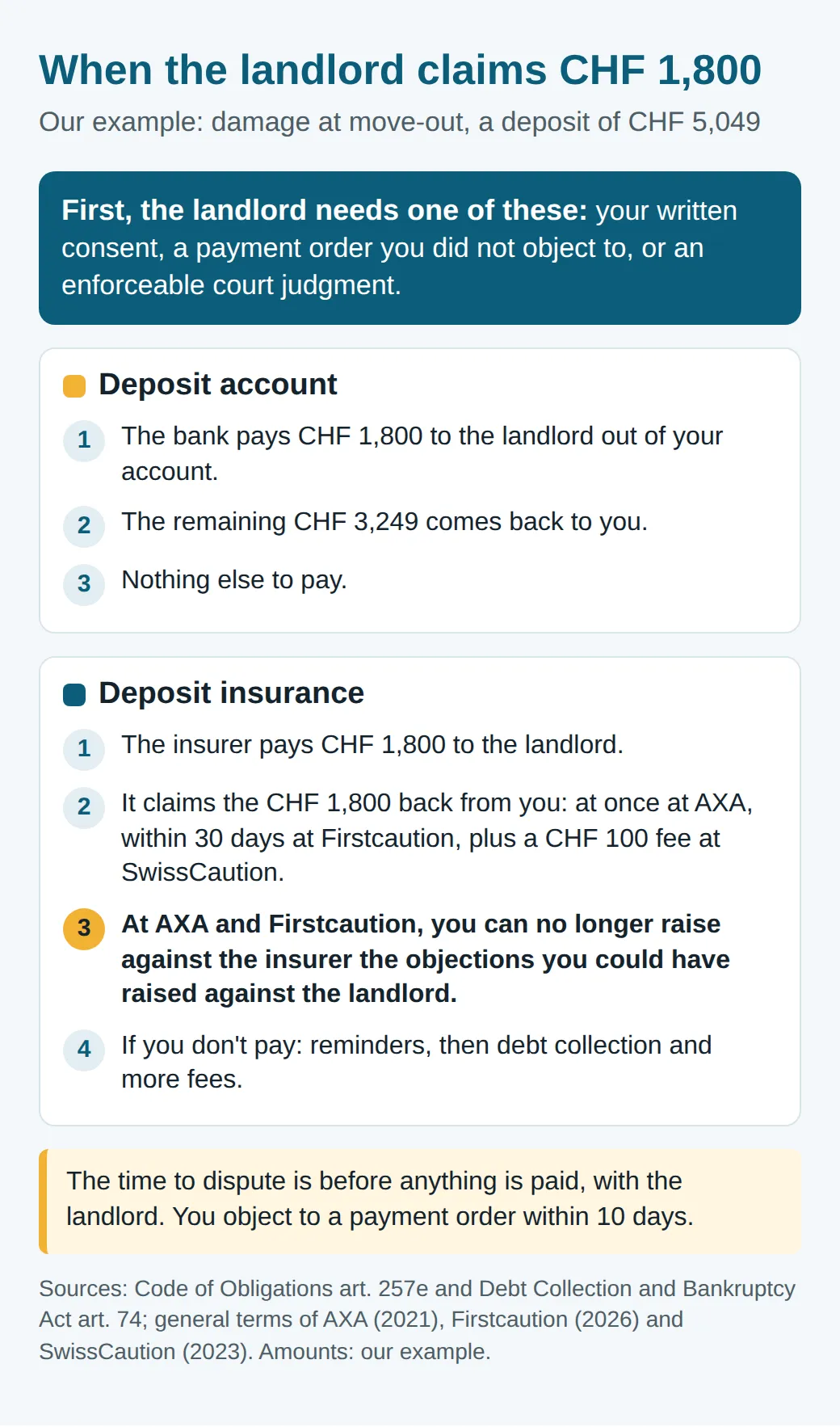
Two clauses are worth reading before you sign. The first sets the deadline and the fees. AXA expects repayment "immediately", and if it hands collection to an outside company, reminder fees of up to 90 francs and 60 francs more if debt collection starts. Firstcaution gives 30 days, then 10 days after a reminder, with at least 20 francs per reminder and 200 francs in fees if debt collection starts. SwissCaution charges 100 francs in admin fees as soon as the landlord calls on the guarantee. If you don't pay, the debt can end up as a debt collection entry in your name, which weighs heavily when you next look for a flat.
The second clause is easier to miss. At both AXA and Firstcaution, you can't raise against the insurer any of the objections you could have raised against the landlord. In other words, under these terms you can no longer argue about the amount with the insurer once it has paid. The time to dispute is before: at the move-out inspection, in writing, and above all when you receive a payment order, which you object to within 10 days. As long as a judge hasn't set your objection aside, neither the bank nor the insurer pays. Our post on the move-out inspection explains what the landlord can really charge you for.
One detail specific to French-speaking Switzerland works in your favour. In the part of its terms for the cantons of Geneva, Vaud and Valais, AXA provides that the landlord can only call on the guarantee if you are bankrupt, if they have obtained a final certificate of loss against you, or if you have moved abroad and can no longer be pursued in Switzerland. That's the logic of the simple surety, the only kind the Geneva and Vaud laws allow for a home: the landlord must turn to you first. The SwissCaution and Firstcaution terms we read contain no such clause. Ask the insurer before you sign.
Premiums can run on after you move out
A deposit account costs you nothing more once the lease has ended, even if the bank keeps the money until the landlord gives consent. Insurance, on the other hand, can keep billing you premiums, and the three insurers handle this differently.
At AXA, the obligation to pay ends with the lease, and premiums already paid are refunded pro rata. At SwissCaution, you pay for as long as the guarantee hasn't ended: the landlord has to return the signed original certificate, or you have to prove that you left the flat more than a year ago without the landlord taking action against you. To cancel, Firstcaution asks for the certificate signed by the landlord or a joint declaration, with 30 days' notice to the end of a calendar year; when the insurance ends, it refunds the share of the current year's premium on request, minus a 20-franc fee.
The one-year rule comes from the law: if the landlord has started neither court proceedings nor debt collection within a year after the lease ends, the deposit must be released. With an account, you wait at no cost. With some insurers, that year of waiting can cost you one more premium. The habit to get into: on the day of the move-out inspection, if everything is in order, ask the letting agency to sign the insurer's certificate and send it back.
Switching from insurance to an account mid-lease
The law leaves you a way out, and it is mostly useful when you move. When you change flats, your old deposit can stay blocked for weeks, even a year, while the new landlord wants theirs straight away, within 30 days of signing in the canton of Vaud. Paying two deposits at the same time is often impossible, and that's where insurance is most useful.
Once the old deposit is released, you can pay it into a deposit account and stop the insurance. The Vaud and Geneva laws let you replace the surety with a deposit at any time, and AXA's terms repeat this for Geneva, Vaud and Valais. In practice, the landlord has to release the insurer: SwissCaution only releases you once a new guarantee has been handed to the landlord and the certificate signed by the landlord has been returned.
Watch out for the first year. At both Firstcaution and SwissCaution, if you cancel within the first year of the contract, the insurer keeps that year's premium. Switching to an account pays off from the second year: in our Lausanne example, each year you avoid leaves you 212 to 286 francs.
Which option to choose when you sign
If you have the money, choose the deposit account, at a bank that charges nothing or close to it: BCGE doesn't charge for managing the account, and BCV takes nothing if your salary is paid in there. You get all your money back at the end, minus whatever the landlord obtains with your consent, through debt collection or a court judgment. If you don't have it, or your old deposit is still blocked, insurance is a reasonable stopgap, as long as you treat it as one.
Before signing up for insurance, check four things in the general terms: the rate including stamp duty, the fees when the landlord calls on the guarantee, the deadline for repaying the insurer, and when the premiums stop. Get written confirmation that the letting agency accepts it. And plan from the start to switch to a deposit account as soon as you can.
Another deadline runs at the same time: if the rent seems too high, you have 30 days after receiving the keys to challenge the initial rent. If you're still looking, the listings for Lausanne and Geneva are here:
Common questions
Can a parent act as guarantor instead of a rent deposit?
Yes, but in Geneva and the canton of Vaud the law only allows a simple surety for a home, and only if you ask for it. With this kind of surety, the landlord must in principle turn to you first. You keep the right to replace the surety with a bank deposit at any time.
What happens to rent deposit insurance in a flatshare when one flatmate moves out?
The insurers' terms make all policyholders liable together. AXA states that it can claim the full amount from any one of the co-tenants. If someone leaves the lease, tell the insurer: Firstcaution asks to be informed in writing within 14 days of any change to the lease.
Is my rent deposit safe if the bank goes bankrupt?
The money in the account is in your name and belongs to you. UBS says a rent deposit account is covered by Swiss depositor protection up to 100,000 francs per client. That limit applies to all your money at the same bank combined.
Can a rent deposit insurer turn you down?
Yes. AXA, Firstcaution and SwissCaution check your creditworthiness, and both Firstcaution and AXA reserve the right to refuse an application without giving a reason. If you have debt collection entries, a deposit account is the safer route, since a bank only asks you for the money.
More from the blog
All posts
Lausanne housing cooperatives: how to join in 2026
Housing cooperatives in Lausanne or Geneva: who is eligible to join, what the cooperative shares cost and how the waiting lists work in 2026.
Move-out inspection in Switzerland: wear and tear or damage?
Normal wear and tear, item lifespans, the landlord's deadline, free conciliation: what you really pay at a move-out inspection in French-speaking Switzerland.

Average rent in Lausanne: 2024 figures by number of rooms
Average rent in Lausanne by number of rooms, for new and older leases, by neighbourhood and in nearby towns, from FSO and Statistique Vaud figures.